Last week it was decided that climbing would not be on the list for sports considered for the 2020 Olympics. Despite concerted efforts by the IFSC et. al., what made the list were wrestling, squash and baseball/softball, all traditional activities, especially wrestling which has been part of athletics competition since the dawn of history. Setting aside any speculation as to the transparency of the process, it seems to me ultimately unsurprising that the IOC opted out but what is more interesting is the degree to which climber apathy manifested itself on virtually every climbing-related forum that I visited in the days following the announcement.
In fact, for the majority of commenters, the tone was one of satisfaction, if not celebration. The sense that climbing areas are already too crowded with people, overt commercialism is getting out of hand, and a feeling that public competition is not a real part of the sport; these were the most prominent of reactions. Not all of these comments were from crusty old climbers. Plenty seemed to come from younger climbers from all disciplines. And in fact the number of posts was relatively small indicating an overall apathy from the climbing community.
My personal feelings are mixed at best. I think bouldering especially has real possibilities for a great display of athleticism and sportsmanship, though some recent setting in the World Cup comps has me wondering. But I also agree with those concerned about a split between "real" climbing and competition climbing growing ever wider. The continued persistence of speed climbing as an event lingers mostly as an embarrassment for both camps, if comments are to be believed. I will say that the bigger issue for mainstreaming competition indoor climbing is sorting out what the sport actually stands for. The Olympic motto is "Citius, Altius, Fortius" meaning higher faster stronger and while faster could be dropped for climbing, the other two are very apropos for the world of climbing.
For the uninformed spectator, and in fact even for the informed one, it is not very clear how these states are actually achieved. To begin with, every serious climber knows that a route or problem overall is not the issue; that instead the shape, texture and angle of a total surface area of a few centimeters can decide the outcome. This is completely different from any other sport in the history of athletics. Track and field athletes do not have to worry about the consistency of their surface nor do gymnasts. Claims that the problems are the same for everyone do not satisfactorily resolve the problem. Nobody should earn gold because their hands are stickier or they are taller or some other micro-factor and it's hard to avoid the feeling that there is something like that going on on some routes and/or problems. These finicky variables which are hard enough for a knowledgeable spectator to discern, are impossible for anyone unfamiliar with the sport to understand in terms of their affect on the outcome.
Yet transforming climbing to an easy set course (like speed climbing) or setting five standard problems of very high difficulty with judges evaluating form and overall routine quality (like gymnastics) doesn't seem satisfactory either and would completely remove climbing from its roots in a way that no other sport in the Olympics has had to do. Plus there is the evaluation problem. Faster seems a very weak way to evaluate climbing skill and speed climbing has never been held in high esteem in the indoor realm. Difficulty is a term that has so many dimensions in climbing that a major challenge in comp setting is avoiding too narrow a set of criteria for the climbers. Plus there is the problem of feasibility being very marginal for many kinds of moves with the result that a climber falls and the game is done or worse, many climbers fall in the same place and separation is made difficult or impossible.
I am not saying that the IOC took these factors into account but I think one of the issues at the heart of making competition climbing succeed is showing where the agon is, the Greek concept of contest that was at the heart of the original Greek games. Comp climbing can feel more like a Rubik cube contest, a very trivial type of areté, what the Greeks understood as excellence and what was revealed in the course of agon. For climbing competition to survive and even thrive, it needs to clearly define both ideas and make them understandable and compelling to a larger audience. While I don't think it's impossible to do this, some clarification is in order in the coming years if the IOC or anyone else (major TV, etc.) is going to get on board.
Saturday, June 1, 2013

Saturday, May 25, 2013
Late Spring in RMNP
 Since the semester ended I have been trying to get up to speed for summer season in the Park. For most of the local bouldering cadre, Wild Basin is the place to be, and I am sure I will visit soon. However more often than not, I like to seek out solitude and especially like locations closer to treeline and the Continental Divide. Lots of snow came late to the Front Range so the high peaks are still deeply covered including of course the boulders in Lower and Upper Chaos. That said, some problems are totally melted out and despite a long slow and tiring approach I have been making real progress on Element of Surprise and the right exit version.
In the coming weeks, a number of problems should be coming into shape, or will need minimal digging. The Centaur boulder is melting out quickly and Tommy's is climbable right now. I would not be surprised if a number of boulders in Upper are ready with in a few weeks but I have not been up there yet to confirm. I have used snowshoes for my last two visits as the snow fields have been pretty soft and the trail has been very post-hole prone.
I have also put in a few visits to Elkland, trying Afrika Bambaataa, a classic V12 crimp problem with a very frustrating first move. It's just around the corner from Bridge of Ashes and a very short walk from the road. The main issue with this problem is that it's getting too warm to deal with the very small holds. By the way, during a recent session I cleaned a potential right exit that heads out to the arete which could add some difficulty.

On my most recent visit, I found a little gem of a problem that I am calling Two Claws (V8). It takes an overhung dihedral and then surfs out right to top out. Good landing, technical moves and a nice line, all close to the road.

All in all I am feeling motivated and ready to take down some longstanding projects after shedding the sloth of winter!
Sunday, May 12, 2013
Midnight Lightning versus What Really Matters
.JPG) |
| Midnight Lightning without the "bolt" |
In comments to his blog, James was called just about every name in the book, invited to commit numerous depraved acts, and of course threatened with physical violence. I am guessing that the majority of these internet bravos would be unable to leave the ground on said problem, let alone make good on their promises of bodily assault. The Supertopo forum was, predictably, full of bluster and sentimental rhapsodizing, and some sensible comments too. Perhaps the best was complimenting James as the "king of trolls" though I think his gesture constituted much more than that.
Coming from the visual arts, I was impressed by two things. First the investment so many had in this symbol, an investment more typical of religious or political imagery and marked with the same rhetoric. Second, and perhaps more remarkable, was the fact that this symbol bore all the hallmarks of an old work of art with years of alteration, restoration, previous erasures and fill-ins, so much so in fact, that it is arguable that no authentic "original" Midnight Lightning Bolt actually exists anymore. In other words it became more a ritual intertwined with memory and history, made even more evocative by the recent death of John Bachar. The bolt had a kind of votive aspect, reinforced by the quasi-sacred status that Yosemite Valley holds in American climbing.
In the 1950s the young artist Robert Rauschenburg erased a drawing by Willem de Kooning, a more senior and recognized painter. De Kooning supplied a drawing that was selected specifically for the purpose and which took Rauschenburg quite a lot of work to erase. Simultaneously an act of rejection and homage, the erasure of De Kooning's drawing both enhanced and undermined the aura of the work of art as an object. Ironically the erased drawing is in a museum in San Francisco, only a few hours drive from the Columbia Boulder.
Now whether James was aware of this precedent or not, I find it a compelling parallel, this staging of a symbolic conflict between generations, one enacted by Bachar's generation in examples such as the drawing of the bolt and the iconic "Nose-in-a-day" photo, itself an image intended to respond to previous team images of previous decades and then replicated and parodied over the years. I think many climbers have an ambivalent feeling about this kind of myth making and preservation. On the one hand, they see the myths and symbols adding context and meaning to their actions. On the other, they have to acknowledge that the truth behind the symbols and legends is more complicated and messy than the stories and pictures convey.

The kinds of erasures that bother me more than chalk marks on a boulder are the ones that come before the chalk is ever applied. For example, a recent video I saw opened with climbers preparing for their ascents by shoveling off a carpet of dirt, leaves, and lichen (in other words, an entire ecosystem) at the top of a problem, vigorous scrubbing with a wire brush, and boulder trundling. I suspect the video has been deleted at least in part because its makers realized that it sent the wrong message to land managers, the general public, and not least, other climbers who might regard these methods as legitimate when opening problems on public lands.
I am not claiming innocence in these matters. I have used wire brushes and modified landings myself, trying always to minimize my impact, but recognizing its presence. Any serious climber has modified the natural state of a climb at some point, killing things, however small, to create a route. My point is not to single out individuals for blame but instead to suggest that climber outrage towards the erasure of a few grams of chalk is misplaced when our environment is under constant siege from human activity, including climbing. Even the air we breathe is being altered in ways that may ultimately prove fatal to entire regions and the species they support. Can climbers muster more sympathy towards the natural environments they visit and work towards a better understanding of them instead of continuing on a path of alteration, consumption and degradation?
The bolt on Midnight Lightning was a symbol, a ghost even, of something long since gone away. Personally I find the erased boulder more compelling, as it evokes the time before the problem was climbed, when it was just a vision. But also its erasure also marks an absence, a sobering reminder of the transience and ephemerality at the heart of climbing, how passing time will reduce even the gigantic Columbia boulder to sand. Nature will come back in its own time and grow over our attempts to make our mark, and thank heaven for that.

Last weekend I saw this up on Flagstaff Mountain. With the aid of a pine cone and the abundant snow that was rapidly melting in the warm spring sunshine, I erased it in a few minutes and went on with my day.
Wednesday, May 8, 2013
Wednesday, May 1, 2013
Unrest on Everest: Some Thoughts on Leisure and Capital
Over the past weekend the climbing world was afire with reports of a high-altitude confrontation between three elite Western mountaineers and a group of native Nepali climbers (I am no longer certain that "Sherpa" is appropriate usage) high on the Lhotse Face of Everest. There are literally dozens of accounts of the incident but the best are probably from UKClimbing and Planet Mountain. The apparent underlying cause of the incident, which involved verbal and physical assault as well as death threats, was a perceived encroachment on the terrain and tasks that the Nepali group was involved with as they were fixing ropes for the spring season on the regular route. I won't relate or try to reconcile the varying accounts of what happened, and I am sure that the final word has not been said (nor may ever be said) about what actually happened. Certainly the incident was serious enough to cause Ueli Steck to state publicly "My trust is gone. I could not go back to this mountain."
One of the issues that is lying just below the surface in many of these accounts is the uneasy relationship between the native economy, native labor, and Western capital. I am not sure how much it is a matter of public record the degree to which Nepal depends on a regular infusion of money via the single destination of Everest's summit. There is no question that Nepal is not a rich country by Western standards and that tourist and mountaineering traffic is a crucial economic benefit. Even for an American or European of means, Everest is a substantial investment of time and money, an investment that, by the way, sees no reciprocity from Nepalese citizens in terms of their ability to travel to America or Europe to climb. Nor is it clear to me exactly how the entire country of Nepal benefits from this kind of activity. I am not sure that the interested parties would be entirely enthusiastic about this question being explored more deeply. There is no question in my mind that the lack of clarity regarding even terminology for "Sherpas" and what they do and how they are paid reflects the problems with a relationship that has its roots in an oppressive colonial past, a past that reverberates into the present.
This brings me back to the deeper problem, one that the climbing world seems reluctant to face, that climbing is, at its heart, a pursuit of the economically privileged often in areas of the world where such privilege might be viewed with suspicion and hostility. I think climbers like to believe that somehow by expending time and capital (which in the West are pretty much the same thing) in a pursuit that is basically useless, that somehow it's innocent or at least innocuous. Climbing narratives return time and again to freedom and appeal to the notion that in the mountains you are somehow free of the structures of society. In the eyes of one author, "Everest is not for climbers" because of "the dues—not dollars—I believe one should pay in order to be granted access to earth’s most rarified places." To me, this sentiment illustrates perfectly the myopia in the climbing world, the failure to see that dues paid in the mountains, any mountains, (I can't help but think of them a bit as country clubs here) are intimately linked with dollars and their relatively easy availability. I agree with the thesis that Everest is now a site dominated by commercialism. But ultimately so is every other major climbing area, to some degree or another. I look at the price of climbing equipment, tickets for flights to far-off places, opportunity costs for not working and I ask, "Who can afford this?" The myth of "dirtbag" freedom and the realities of economics rudely collide in our culture, which bestows, with documented increasing regularity, its economic blessings on an ever-narrowing caste, a caste which defines itself in no small part by rituals of recreational consumption, whether on the slopes of Everest or elsewhere. The freedom of the hills requires fairly high start-up costs for most of us.
I don't expect too much analysis of the 2013 Everest season to dwell on these deeper issues. So much media energy is spent on creating images (verbal and pictorial) for consumption by sponsors and consumers alike that it is inevitable, indeed even essential, that the tensions highlighted by this tragic episode be papered over and the parties involved agree to an uneasy truce. The show must go on. But responsible writers on this episode, in my view, will have to return to this fundamental contradiction at the heart of the sport, that our pursuit of freedom and personal fulfillment will ultimately have a cost to someone or something, somewhere.
One of the issues that is lying just below the surface in many of these accounts is the uneasy relationship between the native economy, native labor, and Western capital. I am not sure how much it is a matter of public record the degree to which Nepal depends on a regular infusion of money via the single destination of Everest's summit. There is no question that Nepal is not a rich country by Western standards and that tourist and mountaineering traffic is a crucial economic benefit. Even for an American or European of means, Everest is a substantial investment of time and money, an investment that, by the way, sees no reciprocity from Nepalese citizens in terms of their ability to travel to America or Europe to climb. Nor is it clear to me exactly how the entire country of Nepal benefits from this kind of activity. I am not sure that the interested parties would be entirely enthusiastic about this question being explored more deeply. There is no question in my mind that the lack of clarity regarding even terminology for "Sherpas" and what they do and how they are paid reflects the problems with a relationship that has its roots in an oppressive colonial past, a past that reverberates into the present.
This brings me back to the deeper problem, one that the climbing world seems reluctant to face, that climbing is, at its heart, a pursuit of the economically privileged often in areas of the world where such privilege might be viewed with suspicion and hostility. I think climbers like to believe that somehow by expending time and capital (which in the West are pretty much the same thing) in a pursuit that is basically useless, that somehow it's innocent or at least innocuous. Climbing narratives return time and again to freedom and appeal to the notion that in the mountains you are somehow free of the structures of society. In the eyes of one author, "Everest is not for climbers" because of "the dues—not dollars—I believe one should pay in order to be granted access to earth’s most rarified places." To me, this sentiment illustrates perfectly the myopia in the climbing world, the failure to see that dues paid in the mountains, any mountains, (I can't help but think of them a bit as country clubs here) are intimately linked with dollars and their relatively easy availability. I agree with the thesis that Everest is now a site dominated by commercialism. But ultimately so is every other major climbing area, to some degree or another. I look at the price of climbing equipment, tickets for flights to far-off places, opportunity costs for not working and I ask, "Who can afford this?" The myth of "dirtbag" freedom and the realities of economics rudely collide in our culture, which bestows, with documented increasing regularity, its economic blessings on an ever-narrowing caste, a caste which defines itself in no small part by rituals of recreational consumption, whether on the slopes of Everest or elsewhere. The freedom of the hills requires fairly high start-up costs for most of us.
I don't expect too much analysis of the 2013 Everest season to dwell on these deeper issues. So much media energy is spent on creating images (verbal and pictorial) for consumption by sponsors and consumers alike that it is inevitable, indeed even essential, that the tensions highlighted by this tragic episode be papered over and the parties involved agree to an uneasy truce. The show must go on. But responsible writers on this episode, in my view, will have to return to this fundamental contradiction at the heart of the sport, that our pursuit of freedom and personal fulfillment will ultimately have a cost to someone or something, somewhere.
Saturday, April 27, 2013
Cracked Bolt Hangers and Other Nightmares: The Future of Fixed Anchors
 |
| Can you imagine clipping this? (Via http://www.adventurerock.com/sections/thescene/blog/the-humble-916th-wrench/) |
If you have been climbing for a while, you may recall encounters with fixed protection that was well past its sell-by date. Drooping,twisted soft-iron pitons with rings, rusted-out angles, rotten lost-arrows and a spectrum of lame bolts and half-assed hangers were par for the course. American ambivalence about fixed protection resulted in quite a variety of unsafe and ineffective methods and tools for installing bolts and pitons. In some areas, the ever-present threat of chopping made many reluctant to invest in high-quality protection. In the 21st century this began to change as an older generation and attitude gave way to a more pragmatic approach to the realities of the climbing environment. Things seemed settled for once.
 |
| A cracked hanger (image via Gripped and rockclimbing,com) |
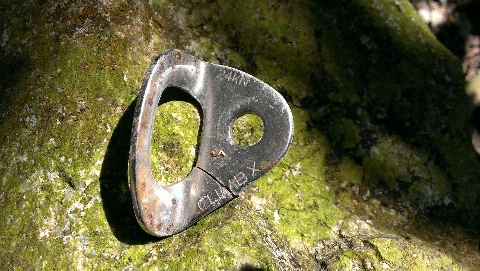
Now comes word of cracked bolt-hangers from a poster at rockclimbing.com who put up some photos on one of the forums and then had the story picked up by Gripped Magazine's website. Obviously this story will develop over the coming weeks but the primary issue is that this failure, if confirmed, is in a device that is in many instances absolutely mission-critical, non-redundant and much less subject to the variables and stresses that say, an actual bolt in the rock or a cam might undergo. In other words, a modern hanger failure simply should not happen, ever. This makes me wonder about what's next.
As climbing expands as a sport, the likelihood of ever-increased use of fixed anchors expands as well. Now there is a UIAA standard for "rock anchors" that focuses on materials and strength tests. There are probably others that can be added such as the CWA and so on. However (and this follows only a cursory search) there appears to be a remarkable lack of publicly available rigorous current research on the subject of placing, assessing and maintaining fixed anchors in the field. Given the fact that there are many freelance bolters out there operating in a diverse range of rock types and environments, it seems logical that there will need to be a serious empirical field-based study of the performance of fixed anchors and any accessory gear including fixed draws, links etc to ascertain future best practices in the manufacturing, installing, and maintenance of these now-essential tools. Will there be a problem commissioning and funding such a study given its potentially controversial findings? As with the integrity of fixed climbing anchors themselves, only time will tell.
If you have suggestions on where to find publicly available, scientifically rigorous research as opposed to anecdotally-based accounts, please let me know. The ASCA is a good place to start but there seems to be room for improvement in terms of resources.
Subscribe to:
Posts (Atom)


 Posts
Posts

