Tuesday, May 31, 2022

Farewell to Print, Farewell to Climbing

 How we went from this:
This is a transformational day for our company and our customers,” Robin Thurston, CEO of Outside Inc., said in a written statement when the acquisition closed. “Everything we do is driven by a belief that a hike, run, ride, or yoga practice can change your life, and these new brands will help us fulfill our mission to build the world’s best consumer experience across a wide range of activities. With these moves, we can now deliver world-class content 24/7 to almost every home in America across every platform, screen, and device.”

Outside didn’t stop there, either. In July, it acquired a trio of cycling brands — video-centric website Pinkbike, road biking and racing site Cycling Tips and GPS trail database Trailforks.

With all of that in its portfolio, Outside launched Outside+, an annual subscription service that gives customers access to all its content, training plans, adventure sports experiences, videos and events on a single platform.

“Our vision was transforming these from print companies to digital platforms,” Thurston told BizWest in an interview in May. “We want to bundle everything so we give you all you can eat of active interest media and activity. Whether it’s active lifestyle or home and cooking — these verticals will attract audiences back. All publishers have to get into the first-party data business and better understand their users to get people to sign in, to use all the services.”

To this in less than a year

"In addition to traditional print media offerings, the Boulder-based company bought a wide-ranging list of active-lifestyle brands, the complete Warren Miller film catalog, mapping services, and even a company that takes finish-line photos at race events. Thurston’s plan was to have those brands become part of the Outside+ subscription model, which targets individual reader’s interests and anticipates future pursuits. The goal: to directly sell content, goods and services to subscribers for an annual fee. In the process, Outside Inc. would de-emphasize the advertising revenue model that has become so challenging for print media. Perhaps most impressively, Thurston told 5280, he’d transformed his company from a few dozen employees to one that had more than 500—and he’d made all the acquisitions without laying off a single person.

That changed last week when the company told its staff in a video conference meeting that it would eliminate roughly 15 percent of its workforce, shutter some of its print publications, and reduce the frequency of most magazines to one or two print runs per year. The change came as a shock to Outside Inc. employees who had hoped Thurston’s ambitions would result in a rejuvenated era for the company’s publications.

“This is demoralizing,” one Outside Inc. employee told 5280 on the condition of anonymity to speak openly about the cuts. “You do the work because of the people around you, all these brilliant minds. Now, people are wondering how long they want to stay in this industry.”

The layoffs were spread across the company, according to a slide presented to Outside Inc. employees and obtained by 5280. Of those listed as “exits,” 31 were from “content”—or 18 percent of that sector—among them, three editors at Outside magazine, the company’s flagship brand. Sixteen employees were laid off from the sales and marketing departments; 13 positions were eliminated from “commerce,” 12 positions were eliminated from “product engineering and mapping;” another seven were “general and administrative” employees. The company’s “events and experiences” and “customer support” staffs were untouched.

should be a story reverberating around the climbing world as it implies the end, not merely of the print edition, but the actual end of the magazine of record in North America chronicling the sport of climbing. Yes there are journals such as Alpinist or ClimbingZine or Gripped still continuing print editions (for now) but none of these have the reach or the mission that Climbing had. And I emphasize "had" because the warning bells should have gone off as soon as folks read Thurston's public statements about platforms and data business.


As in, "It’s about personalization,” Thurston says. “It’s about having data to be able to understand and hopefully predict what you’re going to do next.” As the company aims for profitability within the year, it has plans to break into documentary films, offer more podcasts, and develop short videos for TikTok and Snapchat."

Any non-Thurston-koolaid-drinking entities would have surely recognized that there is zero possibility within the outside industry for media-linked revenues sufficient to support a reported 150mil investment (among other unreported amounts) in this venture:

"The acquisitions resulted from the closing of the Pocket’s series B financing, which enabled investments in audience, technology, and product development, according to information supplied by the company in announcing the additions. The company’s series B financing was led by Seqouia (sic)Capital Operations LLC, which invested $150 million in the company and gained a position on the company’s board of directors."

I will state/predict for the record that there is a next to zero chance for Climbing to still be operating under the Outside Plus umbrella in anything like the form it had say in April of 2022 when 5280 published this pie-in-the-sky pronouncement in a profile.

“Do I think I’m doing something revolutionary?” the 49-year-old Outside Inc. CEO and Colorado native says.  “You know, it’s not like I’m building a rocket going to the moon.”

Outside Inc. would not confirm how many people have already subscribed to Outside+, the service that charges users $99 per year and includes two magazine subscriptions, mapping services, books, reduced entry fees to events, the entire Warren Miller film collection, and discounts on things such as travel, lodging, and gear. But Thurston says he hopes to grow Outside Inc.’s digital subscriber count to 20 million in the next five years.

The web of information and offerings is based on a data model that can anticipate a user’s future activities based on their current interests—and other users’ past interests. Outside+, Thurston says, could detect a customer’s shift from mountain biking to trail running, for example, then deliver everything from news stories, running shoe reviews, yoga and food recommendations, and event sign-ups—plus travel and lodging resources—to a computer or smartphone screen."

20 million? Uh huh. "Outside Inc. would not confirm how many people have already subscribed" says it all. And that "data model"? The vaporware feels are strong with this one.

A coincidental union drive in editorial in January that got quashed/was withdrawn had nothing to do with any of this I am sure.

In the end (and this will end and end badly IMO) the reality that underlay the whole scheme was financial speculation, pure and simple.

In another 5280 piece, Thurston was described as saying to (what was left) of Outside's employees "that current economic conditions made it more difficult in the short-term to move the company from private ownership to a publicly traded company (my emphasis) and forced the cutbacks. The savings, Thurston said, would give the company more operating “runway” in the meantime."

And there (5280 burying the lede nicely) is what was going on the whole time. Blue-sky/fever-dream "visionaries" imagining that the outdoor industry media "space" could generate sufficient buzz (forget about actual revenues, are you kidding) to justify VC capital investment and eventual IPO scenarios. That 20 million paying subscribers would materialize in five years (the classic timeline) and make everyone rich. Except the ink-stained (okay pixel-stained) writers, photogs and editors of course.

Not so long ago Outside was the Everest of outdoor publishing. Writers knew they had made it when their byline appeared in its pages. Significant issues were explored there, careers were made by some writers, and classic articles were published that reshaped the nature of people's relationship with the outdoors. And now what? Thurston predicted in April the arrival of "Outerverse" (NFTs and all) but my guess is what will happen next is more along the lines of Jon Krakauer's classic Outside article and book, that chronicle of hubris, mismanagement, and disaster, Into Thin Air. Because that's where Sequoia Capital's money is going unless something drastically changes at the top.

And in the meantime if there are any responsible socially-conscious investors who want to bring Climbing back from the brink and keep it sustainable for decades to come for a much more modest outlay, get in touch.

Thanks to 5280's Robert Sanchez for his excellent reporting on this subject. Also check out Adventure Journal for their thoughts

Good summary of the whole debacle

Full Disclosure: I have been published in Climbing and the (recently) let-go editor Matt Samet is a good friend. Also I am a subscriber (though not renewing) who has yet to hear anything from Outside Plus about the implications of any of this for my subscription.



Saturday, August 14, 2021

Post-Olympic Climbing: Where Next

 The post-Olympic climbing landscape is now officially with us. It's a topic I wrote about extensively in the past and maybe some posts aged better than others
http://www.mountainsandwater.com/search?q=olympics

This post was probably the one that aged best
http://www.mountainsandwater.com/2013/06/climbing-and-olympics-agon-and-arete.html

In it I argued that comp climbing still has no idea what it stands for in terms of testing athletes. I wrote in 2013:

"My personal feelings are mixed at best. I think bouldering especially has real possibilities for a great display of athleticism and sportsmanship, though some recent setting in the World Cup comps has me wondering. But I also agree with those concerned about a split between "real" climbing  and competition climbing growing ever wider. The continued persistence of speed climbing as an event lingers mostly as an embarrassment for both camps, if comments are to be believed. I will say that the bigger issue for mainstreaming competition indoor climbing is sorting out what the sport actually stands for. The Olympic motto is "Citius, Altius, Fortius" meaning higher faster stronger and while faster could be dropped for climbing, the other two are very apropos for the world of climbing."

Nothing I saw in Tokyo indicated anything has changed. Indeed, the scoring controversies (too numerous to recount here) underlined the problem. Separating speed is a welcome move for Paris 2024 though I would argue that speed will ultimately disappear unless it's changed significantly and soon. But more importantly the fact that some very strong outdoor climbers didn't make finals despite a dedicated period of Olympic training indicates, among other things, that whatever comp climbing is becoming, it's so radically different that a climber who flashed 5.15a outside was out of contention for the podium.

I saw a number of attempts by announcers to convey how climbing difficulty works, attempts that had limited success and were rightly lampooned here in perhaps the best commentary I saw.


So where next? Good question! I imagine the current NBC equivalent of Jack Donaghy looking at speed climbing and saying "Nuh-uh" and the TV appeal of people sliding off boulders barely a foot off the ground has to be tenuous at best, once the novelty wears off. 


In my opinion, the future direction of comp climbing needs to focus on a more relatable athleticism in all the events with a trend towards standardization in what skills and strengths get tested. Bouldering in particular needs to get its act together to avoid looking like a lottery while speed has to get away from the race format and build a bigger better wall and route, focusing on time only.

The larger question is the degree to which climbing's appearance on an international stage will increase its popularity, especially in an already stressed and crowded outdoor environment. That's a hard one to forecast since gym climbing really is so different from outdoor climbing and the appetite for its peculiar problems of terrain protection etc may not carry over as easily as some may think. We will see.


Friday, April 10, 2020

Better Stop Exploring

Like everyone else, well almost everyone, I have a fair amount of time that I once spent climbing that I can now dedicate to browsing the interweb/social medias. Few companies spend as much money shipping their "athletes" to far-flung destinations (which are a thing under discussion in analyzing the pandemic) as The North Face and for no particular reason, I thought about the company motto "Never Stop Exploring." TNF was so worried about exploring they posted this last year:


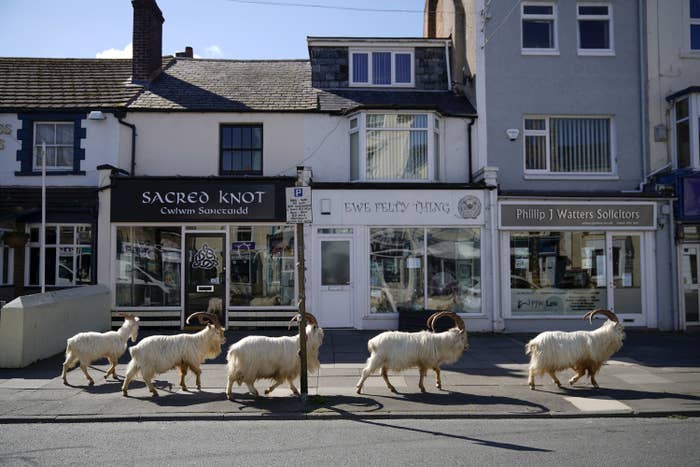
Well climate change is still a thing as everybody knows, but what is actually helping slow down climate change thanks to COVID-19 is (ironically enough) people staying put. CO2 emissions have been down drastically in areas under lockdown and of course everyone has seen this fun photo or something like it from Llandudno in North Wales. The goats (a non-native species) typically live on the Great Orme, a limestone headland (and climbing area) near town. Sadly the dolphins swimming in the Grand Canal in Venice turned out to be fake.
Goats Move Into Welsh Town Empty Due To Coronavirus

The natural world, it seems, is exploring us in some interesting ways. Which is cool. Except when its a potentially lethal virus. Which humans are in a way too, so there's that. But anyway, what is more interesting is a consideration of whether climbing in "exotic" locales is, or has been, contributing in some small way to the release of dangerous organisms into wider human populations. The bats that carried COVID-19 lived deep in limestone caves in China. As it happens, climbers like limestone caves too. It doesn't take a genius to consider how easily something might transfer to a broader population from a climber hiking into an area and "cleaning" (i.e. disrupting an active biome and releasing heaven knows what into the air) a route in such a place, climbing it, then flying out with their gear (covered in heaven knows what) back to "civilization" to make a video about it and encouraging others to visit too. Those others bring yet more people encouraging further disruption and encroachment on wild habitats. These zoonotic transmissions are more and more likely as globalism continues to extend its economic and cultural influence.

I just read in 8a.nu about the establishment of climbing in Suriname, a country on the Atlantic coast in South America. It has extensive natural rainforest areas and apparently some potential for climbing. Yet is climbing good for the wildlife there? And maybe as importantly is climbing there good for us? A New York Times Travel section article blandly describes the market in the capital city of Parimaribo as follows: "Maroons and Arawaks, one of the country’s indigenous tribes, sell nearly everything under the sun from the country’s interior at the Freedom Market — from bush meat to live monkeys and bottles of casiri, a brew made from cassava." Street markets selling "bush meat" sounded so, well, exotic, in 2011. Today, we know that its equivalent in the "wet markets" of Wuhan and elsewhere launched the global pandemic that everything and everyone afterwards will remember 2020 for.

In other words is there a point at which we really would be better off not exploring? When do we finally say enough is enough? Disturbing sensitive ecological areas for fun and profit needs to be looked at quite a bit more carefully going forward, especially in profoundly biologically diverse regions where the human/biological interface is especially porous and potentially hazardous. Climbers like to consider themselves somehow exempt from the laws of nature as they "adventure" around the world in climates and environments that would be better left untouched. When you consider the possibility that one pried-off flake or the disturbed bat nesting area behind it could unleash a pandemic that could kill hundreds of thousands or millions of people and bring the global economy to its knees, maybe, just maybe, it's not worth it?

Note: for a compelling account of the ideological origins of this pandemic, please read "COVID-19 and Circuits of Capital" in which I saw the phrase "the frontiers of capital production," a phrase which perfectly echoes both the terrain and theoretical premise of the outdoor industry and which helped inspire this post.


Tuesday, April 7, 2020

8a.nu (and Mountain Project), Why Are You Still Allowing Climbers to Publicly Post Climbs?

This one is going to be short. Virtually every climbing area in Europe or North America is located in a jurisdiction under "shelter-in-place" at this point. There are various interpretations of this but the emphasis on staying local and avoiding crowds is universal. Rural communities where most climbing sectors are found are pleading for visitors to stay away from them. Climbing organizations are echoing the same theme. Yet every day I see fresh ascents logged in these days and posted on the 8a website and elsewhere for all to see. This is not appropriate for too many reasons to count.

So I am asking these websites to look again at their actions and make changes. It's very easy to put the message out there that public posting of climbs is not helpful at this time. It's also easy to change the settings on the website to make such posting impossible for the time being. For guidance on this, check out UKC's proactive attitude. They locked down their logbooks March 18.

Here are the two primary sources for such posts.

REI owns Mountain Project. No more publicly available ticks of routes please.
8a.nu please just stop. We get that Sweden, for now, is more relaxed about restrictions. How much longer?

Climbers, if you really think that going climbing is okay right now, I can't alter that attitude but I will ask you to stop posting about your sick sends on social media and elsewhere and I can guarantee that if you are sponsored, others are taking note of your lack of awareness, including athlete and brand managers. Times for climbing brands are going to be very tough going forward and failure to grasp the need for everyone to get on board with true social distancing will have consequences.

Thank you.


Monday, March 16, 2020

Climbing Hits the Wall

The world is reeling from the pandemic Covid-19 and fortunately it's no longer still being debated whether it's appropriate to go outside climbing. Ugh. My answer is, right now, definitely not, unless (maybe)  you are free soloing, where, in the event of a mishap, you will likely not strain local medical resources. The thought of bouldering has me on edge (hold-sharing with Broseph and his buds ewww) but pictures of dozens of climbers in close proximity lapping up the Front Range's crowded cragging scene makes me a little freaked out. Meanwhile locals in places such as Moab are pleading with would-be visitors to stay away. (Update: Moab, like Hueco, Yosemite Red Rock Smith Rock, etc. closed) They aren't pleading In Europe, since the authorities are simply quarantining EVERYTHING. Will Instagram will develop a conscience about this issue of #vanlife and outdoor recreation in the time of coronavirus? We’ll see.


But speaking of free solo, the bigger picture (see what I did there), setting to one side the extraordinary catastrophe this is handing to the world's physical and economic health (and hopefully very swiftly setting aside in November the catastrophe's enabler here in the States), this pandemic came along just as climbing was hitting the big time and will be dealing a very hard blow to that surge in popularity.

This is for a number of reasons:

1. Climbing gyms are closing down and it could be a while. This really sucks and not just because I work part-time at one locally. In Boulder and many other locales climbing gyms are an integral part of the climbing scene. They are the place where beginners often get started and where veterans (myself included haha) are able to stay on top of new developments. They support strong climbers through employment as setters and coaches. They host competitions and other community-building events. Though there are downsides to gyms, they remain real anchors for local climbers and sources of community and communication. But their vulnerability to communicable diseases (nobody quite knows how long Covid-19 will stick around) is certainly going to cause both investors and the public to rethink the business model and a few months (very likely scenario) with minimal revenue is going to wipe out more than a few of them. New gyms (and we were maybe hitting peak gym as it was) are going to be facing strong headwinds since the investing climate just tanked. And of course many members or would-be members may find themselves unable to afford paying gym memberships. And you don't want to be a hold manufacturer right now. Nossirr. NO. Which sucks because they provide the cool stuff we climb on.

Pro tip: If you can afford it, PLEASE do not freeze or cancel your gym membership. Nobody else will be open anyway and if you don't support your gym now, it won't be there when you can come back.

2. Goodbye Olympics. Everybody (well maybe not everybody- thanks a lot, speed climbing) thought the arrival of climbing at the Olympics meant its future was assured. And now the chances of the Olympics happening in Tokyo are slim to none, as numerous news stories are predicting. In Italy, a person is dying roughly every 5 minutes. France, Spain, and Germany are locked down as is the EU generally speaking. The UK just woke up to the seriousness of the situation. We’re next. The Olympics are not happening and that's a fact. Only a lunatic would convene tens, probably hundreds of thousands of people in a tightly crowded city hot on the heels, let alone in the middle of, a global pandemic. Repeat. OLYMPICS. NOT GOING TO HAPPEN. (OK that just got confirmed)  And worse, climbing is not going to get a second chance at them because...

3. This pandemic is getting scary. I read things every day that scare me the way watching Free Solo on IMAX never did. Only lunatics enjoy scaring themselves for fun climbing rocks in an already scary world. We used to call such people climbers before sport climbing and gyms made climbing welcoming to more balanced people. Now the world is ultra crazy-real scary and the thought of picking up or even spectating one more risky activity has most of the population reaching for a cozy evening of Netflix and chill. Normalizing death and dismemberment has long been an Achilles' heel of this sport especially given the past year or so's casualty list. Even the North Face "Team" has hired a therapist to deal with managing the trauma that is caused by risking one's life in the mountains with the goal of "testing" gear that mostly ends up traversing college campuses and pub crawls. Also people won't have much money, see above.

4. Governments are going to close down public lands for a while, maybe quite a while. The "dirtbag" #vanlifer roadtrippers are going to be considered as potential disease vectors and invited to quarantine themselves for a couple of weeks in their vans at locations all around the world which won’t be much fun for anyone and a wake-up call to more than a few. The rest of us are going to buy a sh*t ton of hangboards which will wind up on Craigslist next year as everyone realizes how boring and difficult using a hangboard actually is. Watch one of the 5000 videos that have popped up on Youtube recently and see for yourself. And I love hangboarding! Some of us will build home walls but most of them will suck and, well, see hangboard comments above. Long story short, soon there will be an abundance of opportunities for climbers to pick up amazing deals on "intro" level shoes, harnesses, ropes "no falls, only used a few times" and cheap ATC-style belay devices. Climbing gear manufacturers might be having an excess inventory problem very very soon. Also people won't have much money, see above.

So climbing is in a bad way right now. Big time. Along with a lot of things.

If you have any idea how climbing is going to hit the big time now, I would love to hear it. I'll be at Summer OR (seriously, that probably will not be held this summer) or maybe CWA (are you KIDDING ME? UPDATE CWA was cancelled) or more likely glued to social media and the news watching as the world burns and hoping to somewhat save my skin and that of my family. The sick sends will have to take a back seat for quite some time.


Saturday, February 22, 2020

Misogyny in the Rocks

Posted this up on Facebook today regarding this piece on Medium:

https://medium.com/@alexcasar/misogyny-in-the-rocks-the-tinder-pussy-rock-climbing-dilemma-c312712b0777


"Great essay, thoughtful and thorough. Route names in areas that have associations with native culture and traditions, especially spiritual ones, and most especially obnoxious names like the one under discussion, reek of old-school imperialism and colonialism, just under a modern adventure sport guise. The least that climbers can do is honor both the natural setting and native culture in creating and naming them. This goes triple for visiting climbers.
Here in the USA, the most egregious example I can think of are the numerous obscene names for boulder problems at Hueco Tanks, most of which have strong misogynistic contexts, and have no place in a sacred area for Native Americans, not to mention a place with its own natural beauty. Thanks to Fred Nicole for beginning to turn around that tendency with both his amazing FAs and their evocative names. I wonder if/how the new edition of the guidebook will handle this problematic legacy."

Jeff Achey at Wolverine Publishing was quick to follow up with this comment:
"
We all discussed it back and forth quite a bit, and none of us had exactly the same opinion on what to do... In the first edition of the Wolverine book, Matt and Dave retained all of those names. At this point they are part of the historical record, in a way, maybe best serving modern and future climbers as an example. Jason Kehl in particular was against "censorship," and I'm sympathetic to that point of view. Also, the sophomoric misogyny seems a bit pathetic at this point, with women boulderers absolutely crushing in Hueco. Females are so well established in the elite bouldering community there that sexist putdowns lose much of their punch. It makes the misogynist simply look like a fool. But still. It's an unfortunate, weird situation. We did put a note in the intro about obscene names, and did a bit of judicious new abbreviation, but maybe not enough. I'd love to hear more people's comments on this issue and how we guidebook scribes should deal with it! Fortunately most books we deal with don't have this problem in anywhere near the degree as Hueco!"

Thanks Jeff!

My view on this is that certain aspects of "climbing history" and their preservation are very open to debate, especially route names that later climbers find offensive, and that the "rights" of first ascensionists to preserve those names are basically non-existent. The whole FA culture that has developed in climbing (rooted in a quasi-colonialist worldview) itself is a topic for review in another and much lengthier post.

I remain amazed that TPWD has not moved to modify or eliminate its use of any of the route and area names from the 80s and 90s when such names were much more common. I guess we'll see how that works out.

Thursday, January 30, 2020

Starting Up This Time For Sure

So yeah I spend way more time than I should on social media (anyone remember when that wasn't even a thing?) fiddling while Rome burns. But in between that and working I definitely still climb haha. A new thing in the past couple of years has been semi-speed laps on the Second Flatiron behind town. It's a very basic template for running. 15 minutes to the base, 15 minutes up the climb 15 minutes descending. My fastest time is about 38 minutes, the slowest, well a lot longer. Speed climbing isn't really my thing but the Second is pretty much the perfect arena for a steady but mixed diet of aerobic conditioning. It certainly beats easy autobelay laps in the gym!

You might recognize this climber! We did the Second recently as a fun run.
Anyway, this post marks a revival of this blog (as obnoxious as that word is) and I will be updating at least weekly on topics of general climbing interest as well as my own specific activities.

Tuesday, July 24, 2018

Time To Go To Outdoor Retailer?

I've decided after a hiatus to start writing this blog again. A logical step is visiting Outdoor Retailer, now in Denver, thanks in large part to the retrograde environmental politics of Utah. I just sent a registration request to the show so we'll see what happens...

Tuesday, November 22, 2016

Adam Ondra and the Dawn Wall: Veni Vidi Vici

Just about the only bright spot in the unfolding catastrophe that the Trump-era United States is becoming was the autumn visit to Yosemite by Czech master climber Adam Ondra. His plan was to attempt the Dawn Wall, something he promptly got started on, going ground up to investigate the climb and doing substantial amounts of free-climbing on the route including an onsight of most of the last third of the climb. He worked in a trip up the Nose with his dad, in only 17 hours, during this phase as well. After further work on the crux section of the route, roughly pitches 10-16 he embarked on his single push ascent and in eight days was at the top, having cleanly led every pitch free.

Interestingly, in comparison with the media frenzy that accompanied the first ascent, the major source of specific info about the climb was Adam's Instagram posts via his own account, that of Black Diamond and his belayer and more informal photographer Pavel Blazek. Indeed the tone of what media there was seemed to anticipate a comeuppance of sorts, as though Adam would be humbled by the peculiar nature of Yosemite granite and the sheer difficulty of the route. The New York Times, which appears to be uncertainly grappling with its future in the "post-truth" era, had a story on Ondra which came in for justified criticism for both its title and its tone. The title "Adam Ondra Expected a Short, Hard Climb. Now He’ll Be Happy Just to Finish." implied that somehow Ondra had come to the Valley expecting the proverbial walk in the park but had been humbled, a sentiment that came through elsewhere, where the reconnaissance ascent was described as an "aid climb" instead of what it actually was. And of course there was the usual "he's just a sport climber/boulderer/comp climber" internet commentary. One writer stated "It’s safe to say that it’ll be a long time before anyone repeats this rock climb." That was about a year and a half ago.

In the end, despite  the qualifiers and naysayers, the fact is he took the route down in eight days with no real problems to speak of and with plenty of time left still for an onsight attempt on the Salathe Wall. It was done with minimal support or fanfare. It was done using mostly ground-up tactics. Adam was gracious, crediting Tommy and Kevin for their vision and acknowledging the effort and difficulty of the climb, not to mention its boldness. Yet, it's worth saying, he wasn't the only one doing amazing things on El Cap this fall. The Zodiac (5.13d) had a third free ascent, the Dihedral Wall (5.14a) saw a long-overdue 2nd ascent, the Pre-Muir had a 4th ascent and Freerider was rope-soloed free in a day. Oddly none of these were accomplished by "pro" Americans. Where were they? Good question. Climbing boulders in Colorado, some, though still no American repeat of Hypnotized Minds, despite a rapid ascent by Rustam Gelmanov in grim summer conditions. Ticking routes in Rifle? Sure, though Mark Anderson doing Shadowboxing underlined that Rifle 8c+/9a is hardly the preserve of fulltime climbers anymore. And of course there's the Red River Gorge in fall. So what's up? Is everyone too depressed by the election? Too busy staying current on their Snapchat posts?

The Instagram/Facebook game may be strong for Americans but all the social media marketing in the world cannot make up for this truth. Once again the bar has been raised substantially and the question has to be asked whether there is anyone ready to match it? I'll be interested to see who rises to the occasion.

For more insight into Ondra's mindset read the interview I did with him a while back
http://www.mountainsandwater.com/2012/03/interview-with-adam-ondra.html

Tuesday, August 2, 2016

The Five (okay make it Six) Stages of a Route in the Social Media Age

Now that the millennials are firmly in charge of the climbing bandwagon and Brooklyn Boulders is headquartered in Denver, it's time to talk influence, how to get it and how to wield it. Maybe some of you are toting your climbing resumes to Summer Outdoor Retailer right now in the hope of getting free stuff. Maybe some of you are getting free stuff and still want to keep getting it. No matter, you need to get your rep past the bean counters and the marketing specialists and to do that you must understand the process that lets you post that sponsor junkshow shot on the instagrams.

Back in the day (i.e.1895), a hemp-rope-carrying alpine dude named Mummery stated, "It has frequently been noticed that all mountains appear doomed to pass through the three stages: An inaccessible peak - The most difficult ascent in the Alps - An easy day for a lady." Much more compelling stuff than "Because it's there" from that other M-duh-duh-ly guy who also perished up high on a cold (albeit more famous) mountain.


In other words, nothing has changed, including possibly the sexism. If you want a reputation, you have to understand the relative value of your achievement. It's not a bad idea to see it in the context of the Mummery Grade system, a system that BTW uncannily reflects the Gill bouldering grade of B1, B2 and B3. Climbers have to realize that like grades at Harvard (and most everywhere else) climbing grades keep going higher and are worth less and less over time. It's kind of like Moore's Law, except for the fact that really climbing grades don't matter. Okay they do, but we don't like to discuss them too blatantly anymore than we don't want to be that gauche dude who asks  how much that sweet Sprinter van costs.


Climbing grades are like money in a lot of ways. At the top end, those who have the highest numbers need them the least. At the bottom end, we scrape and grind away to get a pittance of reward. But who cares about either of those categories, let's get to the middle class, the climber who is actually well, kind of good, as in C leaning toward B-Team good and thinking that free stuff sounds like not only a good idea but what he or she deserves for that effort, "Murica" being a nation dedicated to free enterprise and whatnot.


How can this aspirant navigate this maze without putting a foot wrong and punting in sight of the chains to use a metaphor that appeals to climbers? How can you ambassadorize yourself with maximum impactfulness through Faceblock, Snapshut, and the Instagraph Machine? These are vital questions lest you have to Kickstart yourself to sponsorship.


It's actually quite simple. First you must familiarize yourself with the (roughly) five (or six) stages of any route. Learn these basic principles and your brandworthyness will rise to the surface like a rich algae froth on a hot summer afternoon. And free stuff will surely come your way.

Stage 1: Nobody can climb the route. The route is impossible. This is getting harder to find everyday, mostly because nobody ever wants to work hard enough to say they can't do it because they aren't strong enough. Conditions, trade show commitments, video shoot on the Canary Islands, imaginary hold breakage, whatever; the excuses are legion but occasionally someone puts  some serious time in and is coming back empty-handed. The rig is really really hard!


Stage 2: The route gets done. It's a thing! Could be someone obscure, could be someone famous (see Stage 3) but it goes and it's obviously hard. Cool. Plus it's a route that people actually want to climb. If you FA it, free stuff might be available. Or not. Hope for Stage 3 to happen soon.


Stage 3: The route gets done by someone famous. This could be the FA or it could be the 2nd ascent or even the 3rd, maybe, but that's pushing it. Okay, now the media spotlight is on the climb. If this is you, you are probably already getting free stuff. But if you aren't, now is your time to shine. But you have to act quickly before it slides to Stage 4.


Stage 4: You get some (limited) attention for simply climbing the route. This is a fragile and easily disintegrating state. You need to get in and do the route while the grade holds and people are interested because of Stage 3. You won't get much attention though because the route then fairly rapidly slides to Stage 5. You probably won't get free stuff at least not from A-list companies. 6th ascent? I don't think so.


Stage 5: You get attention for the category you are in when you climb the route. First Female Ascent, Youngest Ascent, Climb for a Cause, etc., etc. Ironically this might be a very feasible way to get free stuff but choose your objective and social media strategy carefully because the final stage is approaching...


Stage 6: The deadpool stage. This can happen frighteningly quickly. Day late, dollar short. Nobody cares if you did the route. Your friend just did it and even worse your frenemy did it in fewer tries than you. The local climbing team is running laps on it. The crew found six new kneebars. If you post a video, the only people who watch it are mining beta and the Insertgram likes are from your mom. But hey, the best climber in the world is the one who is having the most fun! HAHAHA. LOL. As if. It's time to rethink your strategy if you want free stuff.


I hope this helps you formulate your self-brandification strategy as you monetarize your social media outreach via your FB athlete page and Twooter feed. Happy influencing! And remember Craigslist is always ready to take your free stuff and convert it to hard ca$h.


Friday, May 27, 2016

We Are So Good

The news on social media is that we are all so good. We are winning at life. We are falling down sometimes, but in an interesting way, and we are always getting back up. We are alive. We are smiling. We are laughing with our similarly garbed, similarly featured, similarly vaguely employed peers just enjoying the vibe. There's a lake and a mountain nearby. Maybe a cabin too.

It's cool, an honor, humbling even, to be this good. We are starting up, getting down, and making it happen. Our selfie game is top-notch. We are Instagram-ready, always. Our brand is building momentum. Our Kickstarter is kicking butt, albeit in a friendly, kicky way. Our plane ticket to paradise has been bought, punched and posted up.

We still do Facebook. Of course we do. Curating a life across multiple platforms in a disarming, pleasantly aggressive way takes time. But we're grateful. Really grateful. We've learned a lot in the process and we are always hungry for more. We are so good.

In fact we are always getting better. We are winning at fun, at joy, at savoring the best life can offer. We look great while we do it and we feel even better. We are getting some and this is sweet. We love it. You love it too.

We said "Buy experiences, not things," and we bought both. We are winning. We are getting psyched. We are rich in the things that matter. We will share and we will never ever stop sharing. We always deliver.

We are liking, sharing and commenting. We are inspiring. We are telling our story. Anything is possible. We are faster, harder, keener, more aware and we feel great. We know what it is like to work hard and play harder. We believe. In ourselves. In you.

We are sending. We are humbled and grateful to be sending. We are kinda rad but we know this is just part of the process. We are working on some things. We are releasing trailers and previews. We are having a great time just being part of it all. We are refreshed.

We are having an adventure. This journey is our destination. We are going off the grid. We are getting published. We are at an event. We are part of the event. We are at the premier of a thing. We don't know what to call it. That's cool too. It's all a story. Come check it out.

We really think we are beginning to get it after all. But we're not proud. Just quietly joyful. And that's kind of cool. We are ambassadors. We are stoked. We are epic.

We're reflecting on this. What it all means. How it makes us better so we can be better lovers, friends, and residents of this great big beautiful world. We took some video. We're editing it now. We're thanking our sponsors.

We're celebrating life but we're thinking about why. We're posting something about it. It might get some likes. That's cool.

We are so good.

Friday, April 22, 2016

Why Sponsorship is such a Thing


A couple of web pieces came out recently on a topic that the print journals tend to eschew, namely the peculiar game of discussing who should be a sponsored climber. Andrew Bisharat asked what was up with media and “professional climbers” when the hyped grade turns out to not be all that?

Another post by Georgie Abel, entitled “Confessions of A Spray Queen” appeared to claim that self-generated spray was just part of the cost of doing business and certainly a number of comments on Facebook seemed to agree. Indeed the dominant influence on climbing by marketing seems inevitable by all accounts, even desirable in the eyes of many.

And yet…  I would suggest that the reason the topics of grades spray and sponsorship are so touchy is that deep down we are well aware of the arbitrary and superficial discourse that surrounds the topic. That is to say, a motion is made to defer the decisions on remuneration to companies who hope to sell products because, hey, capitalism, and the people have spoken and apparently the people want young vibrant millenials in somewhat skimpy clothing clustering at the base of a boulder at Red Rock or Bishop. Or that we are all special and everyone has a story, whether it’s on a 5.8 or a 5.15, doesn’t matter, because community, and we’re all in this together, really, bound by inspiring words on Instagram. But in the end I would argue none of this really satisfies those who are serious about the sport of climbing.

So why not? I don't hear nearly as much speculation and controversy in other sports regarding who deserves support and why. Are other sports infested with the same sense of grievance and complaint regarding compensation? It's remarkable to see this especially in relation to such a small overall pie, a pie the slices of which remain an unknown quantity owing to nondisclosure clauses in sponsor contracts, again something unheard of in real professional sports.

I'd like to suggest a few issues that climbing presents when we decide about "athlete" support, questions that are endemic to the sport if not actually unique to it. I apologize for the quote marks around "athletes" but I feel it's appropriate given the Greek etymology of the word which specifically refers to contests.

1. There is no fixed objective standard to any achievement in climbing.  Grades? At best a variable quality, grades rise up and wither away, changing from week to week, place to place, person to person. There is simply no compelling way to prove who the best climbers actually are and who is logically deserving of support. In the context of other professional sports this is insane. To succeed in major league baseball, football, etc, you must perform in public at an agreed-upon level against similarly able competitors. In climbing there is no such requirement nor are there organizations who determine who is eligible to compete in sanctioned events that would truly decide who is worthy of support. In climbing you can do what you want and if it appeals to the right set of people you can actually get paid. Crazy but true. Which leads to #2

2. There are no actual teams or governing bodies that have a set standard regarding compensation or support in relation to performance. Did you hear about The North Face "team" tryouts? Me neither. The word team is thrown around a lot but are they actual teams? No, in large part because of #1. Nobody in the climbing media would dare call out a company for sponsoring an unworthy athlete or speculate who would get cut from a "team" the way regular sports journos do. And since there is no way to determine who or what a valuable player actually is, everyone is defaulting to commercial justification for sponsorship.

3. The standard for sponsorship is increasingly social-media-oriented, which is to say presence on the big three SM platforms; Facebook, Instagram, and... well I forget, but it sure isn't Twitter. Anyway this creates big problems for people who are good at climbing but not so good at marketing. Some reply, "Well that is the new reality, that "athletes" have to be good marketers, not just, in fact not even, good climbers, because what matters to sponsors is how many shoes or raincoats or whatever can be sold thanks to that 'athlete's' influence in social media." And hey anyone can count Instagram likes or #s of video plays and tell themselves that supporting a mediocre but high-profile athlete translates into ROI. But this rapidly degenerates into #4
Sly keeping it on the reals. We've all been there though. #legday

4. Image is becoming everything. Ironically, there was a time when real climbers derided commercial attempts to represent the sport either in entertainment or advertising. Cliffhanger, the notorious 1993 movie, its title a spoof on the serial thrillers of yesteryear became notorious for its failure to mesh together Hollywood action and the world of high-level climbing. None of the climbers involved, to my knowledge, looked upon their participation in the project as reflective of the actual sport. It was a highly remunerative job and that was pretty much it. Today real climbers actively court interest in their activities by any means necessary (American Ninja Warrior anyone?) including of course relentless social media updates, designed to induce FOMO in their followers. Whether anything is actually accomplished is increasingly beside the point. Which leads to 5...

5. Image has nothing to do with athletics. Or at least it shouldn't. But sponsorship clearly has a lot more to do with image than it should. And the problem with image (and therefore sponsorship) is that we know the qualities that go into a desirable image have a lot more to do with accidental qualities like innate charisma and appearance than they do with deliberate and therefore morally laudable effort and dedication and that unfortunately in too many instance image plays into easily marketable stereotypes, especially for young women. Obviously the marketing unicorn is the climber who has both attributes but there is little doubt that the benefit of the doubt will go not to the less-attractive achiever but to the lower-achieving attractive climber. And given the lack of structure or criteria for judging achievement outside of commercial viability, that is no surprise. Money talks and everything else walks.

So in a relatively anarchic world of unjudged and unjudgeable climbing "athletes" each doing his or her own thing, with no clear path to joining the ranks of the "pros" and of course nobody saying what the actual financial reward is for any of this, it is hardly surprising to find that there is controversy regarding who deserves what, especially as any compensation involved is relatively small and hardly adequate to support a truly "professional" status. The controversy is enhanced by images of said "athletes" hard at work leading a fairly laid-back life that consists primarily, if we read Instagram correctly, of climbing what they want, where they want, when they want and how they want.

Takin' Care of Business and workin' overtime


This is not the life led by athletes in major actual professional sports. Those actual athletes lead high-pressure lives with relentless practice and travel schedules often with serious risk of degenerative disease as in the NFL, always in the public eye and always with significant risks for non-renewal owing to poor performance. To get to this place, such real athletes have endured years if not decades of specializing in their sports, beating significant odds and a host of competitors to get there. Their compensation is not just a matter of public record; it is a critical aspect of their identity. We may decry their often extraordinary salaries but we rarely dispute that they have worked remarkably hard to get there. But there is no way to get an NFL contract merely by looking good or keep said contract by having many thousands of Instagram followers. Yes lucrative endorsements may follow a winning athlete who has sufficient charisma but in real sports, charisma is never enough. You must win and win convincingly or face the risk of getting cut. And because such a thing does not exist in climbing, we wonder about the score and who is keeping it.

Sunday, February 7, 2016

To Blog or Not to Blog: Is that the question?

""There is only one thing in life worse than being talked about, and that is not being talked about." Oscar Wilde

 I have been diving deep in the waters of writer's block for the past year, in part because I have been really busy, bogged down in family, work and actually training and climbing. The other issue is deciding what's worth writing about. I tend to seek out issues of contention instead of the feel-good mode typical of most climbing media these days. It's not that climbing is not worth writing about but that the current ecosystem of magazines, videos, and social media posts is a self-reflecting pond of complacency and plenty of marketing. How to move past this to the real thing is the only interesting path to follow in my view. To cut through the noise and image seems the only goal worth pursuing.

 Truth is I don't mind marketing per se. We all need things in order to climb well. Good products deserve our support. It's the mindset that in the end the market is all that matters that is the problem. Climbing becomes a mere conduit to the market and the value of a climb is its marketability. This is giving rise to a startlingly large number of social media presences who are far more about the marketable personality and photogenics than substance. If I point this out, I will be described as a "hater" and a critic. But what's wrong with being a critic?

 Basically there is a double standard at work here. For whatever reason, someone decides to tell the world about something and how awesome it is and then there is a video or a Kickstarter, etc. The key point is that this person wants something from us. Attention, time, money, whatever. They want to be recognized for their work. I consider this kind of presentation more of an argument than a statement of fact but many are surprised that a statement regarding the excellence of something could be debatable. In the current mode of thinking a critical reaction is seen as a problem, as though somehow everyone has an equal opportunity to be heard and to benefit from it. This equality of opportunity and reward is to say the least highly debatable. Why can't we say this and debate it?

 In fact climbing used to be full of arguments and critique. Questions of style, ethics, the environment and so on filled the pages of climbing magazines and journals in the past. Granted that some of this argument was competitive bluster, nevertheless a lot of it was actually serious and very relevant to the present day, which, for the most part, sees next to no discussion in public fora on important topics in the areas mentioned above. If we factor in the deadening hand of social media which tends to flatten all too quickly the contours of a question and combine in with that a general tendency to present a cheerful and likeable social profile, suddenly there is a vacuum regarding serious discussion of serious subjects.

 This vacuum certainly exists today. If any readers can point me to people writing regularly in even a mildly polemical mode, let me know. I'm still making up my mind as to whether it's worth it. I kind of think it is but then again I'm a busy person with too much to do and not enough time or money to do it. We'll see.

Saturday, September 19, 2015

Reel Rock 10: A Review

Last night I caught the second showing of Reel Rock, the closest thing the climbing world has to a blockbuster release, or at least it was until Meru and Everest came out making this fall one of the busiest for climbing video in quite some time. I doubt I will ever see Meru or Everest so this will have to do.

Reel Rock is kind of a big deal here in Boulder, since it acts as a showcase not only for Big Up and Sender Films ( they are the only outfits whose work is shown at Reel Rock) but also for local and national climbing and outdoor brands, whose tables and tents I wandered by in the "vendor village" after picking up my ticket. So it's a thing for sure, especially for the increasing number of young adventurepreneurs who seem to be flocking to Boulder to feed off the outdoor media buzz the town generates.

Readers of this blog know that I have a jaundiced view about outdoor media buzz as it is, that my view is that the distance between reality and image seems only to be widening as the public's access to climbing via HD video is increased. I wasn't impressed by last year's "Valley Uprising" and wasn't planning on going to this year's Reel Rock until I was offered a ticket by a generous third-party donor. So why not? At least I would get to check out the latest style in plaid short-sleeve shirts.

After the usual sponsor shout-outs faded away in the dark cavernous interior of the Chautauqa Auditorium, the films opened with "A Line Across the Sky" which chronicled the voyage of Tommy Caldwell and Alex Honnold across the Fitzroy massif's ridgeline. This climb was a big deal and the trailer on Youtube gives a good sense of the full movie, in fact to be honest, it's not a bad substitute for it since the vast majority of the footage is that taken by Honnold and Caldwell presumably from a Go Pro. Comedic moments from the climb dominated the full-length feature giving a bro-ey vibe to the film even as Tommy tried to explain the conflicts between high-level, potentially fatal, alpinism and the desire to be there for his family after it was all over. The fact that really nothing went wrong, the weather held and that the climbers were certainly more than equal to the task meant that any real sense of conflict, suspense or uncertainty was pretty much absent. Just a couple of guys up in the mountains having a good time.

Next up was a tribute to the recently killed Dean Potter. Again nothing that reached deeper into this man's life, just "sick" footage that most in the audience would have seen elsewhere of the usual highline, BASE jumping, soloing stuff. And then the lights came up for an intermission.

The next film "High and Mighty" was ostensibly about bouldering but what it was really about, apparently, was that bouldering is all about "manning up" and falling from way up there. Daniel Woods felt a bit like a sacrificial victim here, set up in the film as a lowball hero who finally learns the "real" way to climb from Jimmy Webb, especially after Jimmy repeats the Nalle Hukkataival V15 monster in South Africa called Livin' Large while Daniel is shown flailing on TR on the same problem.

The only problem with this plotline is that it is total BS. Daniel has plenty of gnarly highballs to his credit including Lucid Dreaming and Evolution in Bishop and Shining Path in Red Rocks. Furthermore his ascent of the Process, which is what "High and Mighty" was supposed to document, actually occurred six months before Jimmy repeated Livin' Large." Thanks to the way the film was edited, uninformed viewers would assume that Daniel, who is shown earnestly trying to master his fear of falling from the top of the Process (and no f#*king wonder) via meditating and self-help books was some kind of novice at "real" bouldering, at least as it's described by the double-artificial-hipped and multiple-concussed John Sherman.

Really, this segment upset me the most as Daniel is one of the strongest climbers in the world and has established first ascents and demolished numerous testpieces around the world. To fabricate this rivalry between Jimmy and Daniel, who are very good friends, on the basis of who can "man-up" when the occasion demands is nonsense and does a disservice to the sport of bouldering as a whole. I have discussed this with John Gill on occasion and he has made clear his impatience with the notion that bouldering needs to be dangerous to be considered worthy. Heroics were precisely what he sought to avoid back in the 50s and 60s when his most innovative problems were established. Only a later wave of boulderers sought to create a different approach, often based on the headpointing style common in Great Britain. Gill's answer to these debates? "Use a toprope." Problem is that doesn't create crazy footage or a compelling story for a general audience. Oddly the film omitted the fact that not long after Daniel's ascent, a crucial hold broke off the problem rewriting the story yet again.

In terms of actual audience response, by far the most popular was the segment about the 24 Hours of Horseshoe Hell. The rivalry angle was played up again here between, yes him again, Alex Honnold, and the team of Nik Berry and Mason Earle as to who could get the most points/climbing done in 24 hours. Laugh-out loud funny at times, its light-hearted approach to climbing was welcome relief from the earnestness of the previous three segments.

The last piece was a short preview of the Dawn Wall ascent from this spring and not a finished film so I'll pass over it in the hopes that it will reach fruition later this year.

Overall reactions: No stand-outs, that's for sure. Upside? Lots of laughs at times which was welcome. Some excellent aerial footage in Patagonia and elsewhere. Downside? Kind of a bro-fest. Virtually no women appeared in any of the films. A few comments from Becca Caldwell, some drunken women turning up at the Horseshoe, and other assorted brief appearances but in 2015 for no women to be profiled in-depth seems a shame. Another peculiarity and maybe blame climate change, but there's a lot of night-climbing and headlamp footage and frankly that's something nobody's going to be psyched to see a lot of.

In conclusion I would like to see a climbing film collection that was much more widespread in its scope featuring other film-makers and locales. The other issue is the types of stories being told. They ultimately feel relentlessly upbeat, even awkwardly jokey when they shouldn't be, naturally triumphant at the end and in some ways profoundly unreal. Great stuff for a studio's highlight reel or a sponsor's marketing campaign but hardly a believable portrait of what it really takes to get these remarkable climbs done. It would be nice to see truly innovative film-makers emerge to take advantage of the remarkable new technologies out there but so far I haven't seen it. Maybe someday.

For more info about the 400+ locales Reel Rock is going http://reelrocktour.com/

https://www.youtube.com/watch?v=mXNOTJFEBsQ


Wednesday, May 20, 2015

What We Talk About When We Talk About Death in Climbing

"To the living we owe respect, but to the dead we owe only the truth" Voltaire
The world of climbing has been in a state of shock since learning of the death of Dean Potter and his companion Graham Hunt in a BASE jumping accident near Taft Point in Yosemite last Saturday. Among other effects, this accident rapidly brought back to earth the climate of euphoria and celebration that existed in the wake of the Dawn Wall ascent in March and the movie Valley Uprising that ends with footage of bootleg BASE descents in Yosemite. Maybe climbers are revisiting hard truths about the vertical environment that cannot be easily dismissed as handwringing or timidity or obscured through redemptive fantasies of "he died doing what he loved" or the like.

The truth is that climbers become remarkably inarticulate in the face of death. Far too many use euphemisms like "passing" or even worse "transitioning" as if slamming headlong into granite at 80 mph is like switching trains or getting a new job. Others implicitly praise themselves for somehow learning something profound or growing from the death of another climber. Pseudo-mystical or poetical utterances about imagined afterlives and "happy hunting ground" scenarios abound. But the truth seems to me to lie elsewhere, away from the quasi-religious speculations and faux-Zen platitudes, the worst of which are expressed in this video interview with Dean Potter. What business a clothing manufacturer has discussing the most serious and unknowable aspect of human existence is beyond my ability to fathom but there it is.

Death is something about which we ultimately know nothing beyond our perceptions of a once-living thing now gone. In climbing it takes on a spectacular aspect because of the nature and locations of most climbing deaths. In dangerous situations climbers like to say they have "cheated death" or "escaped" it, the most foolish saying they "defied death." Death doesn't get defied or escaped, it just is, like math or physics. Climbers like to credit their will or their "mindfulness" or whatever in somehow overcoming death but it seems to me that death works in the way of most things in the universe, things that exist eventually are destroyed, dissolved, disintegrated, and obliterated. In the words of David to his son Solomon in the King James version of the Bible we "go the way of all the earth..."

Climbers have an especially hard time with death because it brings up a number of unpleasant truths we all devote considerable time and energy avoiding. Among the mot important is the fact that we do not have the level of control over ourselves and our environment that we like to pretend we do. There is a kind of selection bias involved whereby, having survived a situation, we imagine that it was because of our preparation, our courage, our choices, even our moral character when of course any number of things could have happened beyond our ability to control that would negate those factors. A climber's death is the surest evidence of the limits of this way of comprehending the world. Thus we turn away and imagine that we would never be caught in that situation ourselves, that we are somehow made of the right stuff

We also like to believe that our aesthetic responses to dangerous situations confer some kind of immunity to harm or catastrophe, or at least provide a justification for being there. As with the magical thinking described above, climbing deaths abruptly foreclose on the rapturous wonder of high places forcing the awareness of the terrible price to be paid for being in the wrong place at the wrong time. Just because we have or believe we had certain feelings about climbing can we really claim that a violent death is justified by those feelings?

Most chillingly to me, that aesthetic feeling leads to the "he died doing what he loved" reaction, a dubious consolation at best. Climbers die hitting objects at high speeds or being hit by those objects. They die smothered in snow and ice or freezing to death. They do not expire blissfully having just completed the climb of a lifetime. Again reality is elided in favor of a fantasy best summed up by the ridiculous but oft-quoted phrase from Peter Pan: "'To die will be an awfully big adventure." This romantic Rupert Brooke-ian nonsense, which was seen often in late Victorian and Edwardian England, died a less-than-glamorous death in the muddy battlefields of the Somme and elsewhere in World War I. However it keeps popping up in the sport of climbing, a sport which in many ways finds its historical origins from that time and culture.

Climbers know deep down that their sport, which is by any rational measure, without real purpose or justification, is potentially very very dangerous. By some this is seen as a form of character-building virtue in its own right, "the moral equivalent of war" as the founder of Outward Bound Kurt Hahn quoted William James. I am skeptical of the extension of this to climbing, not least because there is no moral equivalent of war, war lacking any morality in the first place. Arguing for climbing as a morally virtuous activity because of its danger ignores the very real consequences of that danger and its largely amoral component. The serac doesn't care when it falls, the loose hold merely breaks when it's pulled on. Just because climbers might project a psychological or moral structure to their activities hardly necessitates that such a state actually exists in reality.

Too many authors to count have commented on the fundamentally amoral aspects of combat. From the beginnings of Western literature with Homer' s Iliad and Odyssey, we see the first-hand accounts of those who were there emphasizing not glory or redemption but confusion, disaster, decay and misery. Knowledgeable climbers know that the same applies to climbing accidents yet the same tropes are pulled out to justify what we do: the aesthetic response, the joy, the intensity, the bonds of friendship ("we happy few, we band of brothers" to quote Shakespeare) the claims to heightened awareness, the "carpe diem" BS that clogs online climbing forums every day.

Particularly frustrating is the fact that at least in part this is used in the service of commercial interests, a game that Dean was forced to some degree to play to remain a professional climber. Are words like "risk" and "extreme" just euphemisms for "potentially deadly," euphemisms that are used to sell a vicarious adrenalin rush to an uncritical audience? Should we be thinking more clearly whether the vision of sports sold by Red Bull, to take the most egregious example, is really worth supporting? As long as we stay in denial about the realities of death and dying in climbing apparently the answer is yes.

So how should we respond to climbing deaths? In my view, we do best by acknowledging the truth about them, that they are ugly, they are real and to some extent unavoidable, simply statistically unavoidable since we are imperfect beings in an imperfect world. We should also acknowledge the possibility that there is really only loss to the survivors, that trying to create redemption in fantastic or magical thinking only denies the truth of someone's death. If the climber or climber's family was deeply religious, that is their business and not the concern of those outside that close circle. We should certainly not try to fit a climber's death into a preconceived idea about how or why climbing should be practiced. Nor should we be fatalistic about climbing deaths, overly accepting of them. They are as mentioned above, unnecessary, ugly and devastating. If we learn from them, it should be on the most humble terms possible, acknowledging and honoring the sacrifice of life above all.

I still think it was best expressed by the survivor of one of the most notorious climbing accidents of all time, Edward Whymper: "Climb if you will, but remember that courage and strength are nought without prudence, and that a momentary negligence may destroy the happiness of a lifetime. Do nothing in haste; look well to each step; and from the beginning think what may be the end.” What the end might be for each of us is unknown but I think we would do well to consider it deeply from time to time. In the words of John Donne, "never send to know for whom the bell tolls; it tolls for thee."


Thursday, January 15, 2015

Valley Uprising: A Review

Some months after the Boulder premiere of Reel Rock 9's feature film "Valley Uprising" I was finally able to view it. It played to sold-out crowds here in Boulder and generally the reaction to the film that I heard was favorable. At least two other bloggers were given advance viewing (I wasn't invited or given access to the film before or after its release) and they were a bit more skeptical, with Andrew Bisharat decrying the nostalgia aspect of Stonemaster-oriented media and Wesley Summers noting, quite accurately, that the film consists largely of deftly recycled visual material from earlier productions.

I knew from the trailer I would have a skeptical response and not being a member of the inner circle of the climbing world has its advantages in this respect. I have the freedom to step outside what has become a very self-celebratory scene and give an honest opinion and appraisal of its products. Because of the serious scope of the project, I think this film deserves a serious and more objective view.

I think a lot of this self-celebratory tendency is revealed in the reactions to "Valley Uprising" which is a historical survey of climbing in Yosemite Valley from roughly the late 1950s up to the present. While its main audience is intended to be climbers, there are nods to a general audience, not least in its paradoxical title which hints at rebellion and unorthodoxy, which is of course a staple of mainstream corporate marketing these days. In aiming at this broader audience however, something important is being lost.

"Valley Uprising" is organized into three main eras defined by (more or less) the leading personalities of the day. This lends itself to broad generalizations and myth-making as occurs in the case especially of Royal Robbins and Warren Harding and the Dawn Wall episode. Harding died in 2002 and while I am sure he would have thought this film project amusing, I doubt we are given a clear picture of his personality which seemed above all to be that of a regular working Joe with a penchant for suffering. Robbins, who I talked with after the publication of the first volume of his autobiography, was a genuinely creative and highly motivated climber whose greatest hour might not have even been the famous Salathe Wall but the unmentioned North America Wall, an ascent which ushered in the great age of El Cap's right-side A4 and A5 horror shows.

The era of the Stonemasters is complicated by the absence of Charlie Porter, again recently deceased, who reshaped the future of El Cap with routes like Mescalito, Tangerine Trip, The Shield and the well-traveled Zodiac and possibly just as important, Ray Jardine, whose redefinition of style and method ushered in the era of hard free climbing and whose "experimentation" on the Nose facilitated the free ascent by Lynn Hill. Both individuals seemed never to have been embedded in the Valley scene and Jardine in particular was viewed with considerable suspicion because of his "hangdogging" and willingness to work routes initially too hard for him.

The star of this period is of course Jim Bridwell but even more so the air of rebellion and counterculture embraced by Bridwell and his followers. Part of this of course was linked with the popularity of drug use at the time but it is telling that in interviews with climbers from the time, it is clear that in the only actual "uprising" from this time, the Stoneman Meadow riots of 1970, climbers stayed conspicuously away from the action. The only net result of this conflict was apparently a tighter presence of law enforcement, something the resident climbers would have been anxious to avoid. This supertopo discussion fills in the story from the climbers' side and makes clear that this non-climber related incident really changed the dynamic between park officials and climbers, a dynamic that remained in place well into the 90s when the demographics of climbing began to change and it became more mainstream. In the end the movie fails to flesh out the fuller picture as to why rangers have to do the job they do. Climbers are described as somehow special, above the law by virtue of being climbers, not realizing that without laws, without "the man," the park would not exist at all. It is certainly naive to imagine that because you can climb a big wall, you should have free run in a beautiful place a few hours drive from a major city.

(This PBS documentary gives some background on the job of a ranger and what rangers were thinking of their jobs in the mid-1980s. A persistent theme of rangers not wanting to be cops emerges.
https://www.youtube.com/watch?v=DpdPz0cq8jk

This supertopo discussion has more on the theme of rangers and climbers. Needless to say it's a popular topic but the advice of the majority of commenters is keep your head low and don't break the law. Not exactly the stuff that's going to entertain audiences.
http://www.supertopo.com/climbing/thread.php?topic_id=870550&tn=0&mr=0 )

More important is how the rebellion theme basically overlooks hugely important things like, say, climbing. So the free-climbing achievements of Ray Jardine are not mentioned, Ron Kauk's achievements are overlooked, though his routes are critical for the time and at the tail end of this time, the incredible achievement of the Salathe Wall being climbed free is not even mentioned. The exploratory efforts of Mark Hudon and Max Jones aren't mentioned either. Henry Barber, definitely not a rebel, is ignored. Instead it is the familiar narrative of John Bachar, super soloist, which brings up another issue.

It is remarkable how much of this film features recycled footage from films that many many viewers will be familiar with. TV show such as American Sportsman, Wide World of Sports and excerpts from Masters of Stone videos abound, not to mention standbys such as "El Capitan" by Glen Denny. Interspersed with the special-effects altered still photos from this era, the visuals add to an overall patchwork/collage effect and serve to undermine a bigger sense of visual or directorial unity. In an extreme example of this, a voice-over describes the first ascent of Half Dome's NW face while footage and pictures of El Cap are shown. To a non-climber none of this matters, I suppose, but it reveals the degree to which the vibe of the story outweighs actual accuracy.

This is echoed, so to speak by the interviews which are mostly choppy and extravagantly larded with profanity, perhaps to emphasize that the greying and paunchy men you now see were once upon a time actual masters of the universe who could stand up next to a mountain and chop it down with the edge of their hands. It seems to me that bourgeois middle-aged guy profanity should be reserved for times like hitting your thumb with a hammer or drinking with your friends, not films where families and kids might be present. But I digress.

That is why it is such a breath of fresh air to see and hear Lynn Hill, one of the few real survivors from this period (along with Peter Croft who, you guessed it, isn't mentioned.) Lynn Hill has remained a serious climber in a way unmatched by virtually all of her contemporaries and there is a certain wry wisdom in her words as she dissects the testosterone and posturing of the male peacocks of Camp 4. One wishes there was a lot more from the women of this time, especially regarding the pretensions of the male-dominated scene, but unfortunately we are left wondering how they fit in.

The film closes on the more-or-less present where the Stone Masters are replaced by the Stone Monkeys. Setting aside the issue as to whether such a group ever had the status of the Stonemasters, these individuals lack the historical distance and gravitas of their seniors and for them is reserved the indignity of hiding out in dank caves as opposed to the luxury of endless weeks in a restriction-free Camp 4. There is something very reflective of the general economic picture for young people these days but that is not developed very much, if at all. Dean Potter, who blew the lid off speed climbing The Nose, is the patron saint of these climbers, climbers who increasingly are mixing walls and vertical mediums, especially the medium of BASE jumping.

By far the best scenes in the film are the contraband BASE jumps. The blather with escaping rangers etc. is neither here nor there. Obviously BASE jumping in the Valley needs to be prohibited or it would be a nightmare on many levels. But for cinematic appeal, there is no doubt that a GoPro view of tunneling through groves of pine trees at high speed beats the heck out of crawling up granite walls, even if you are watching Alex Honnold soloing Half Dome. However the history of BASE jumping goes way back, well before the present day. Ray Jardine has an intriguing mention of hang-gliding into the Valley on his website.

And speaking of Alex Honnold, those in the know will savor the irony of watching America's best known (and very lucratively sponsored) climber living the simple life, driving into the Valley, and punching in at the entrance station, before heading off for another day of hair-raising soloing. You have to wonder if only Alex can afford to live a pure climbing lifestyle, unlike Chongo Chuck or the other cave-dwelling ne'er-do-wells. He and Tommy Caldwell, who, along with Kevin Jorgeson recently (yesterday, just Google it) freed the Dawn Wall on El Capitan, are the new face of Valley climbing, about as far from rebellion as it gets. The only people I have seen that were upset by Tommy Caldwell's work on the Dawn Wall for example were some querulous SuperTopo residents warbling about whether there were too many added bolts on the formerly aided sections, a ludicrous question but one that periodically reappears.

In a nutshell, I'd argue that the rebellions contained within the history of Yosemite climbing were largely internal, fueled by the prosperity of the American empire and in no meaningful way offering real alternatives to that empire's triumphant vision of capitalism and materialism. The fact that a significant number of the stars of the 60s and 70s went on to establish very successful businesses of their own speaks to this. The true rebels such as Chuck Pratt or Charlie Porter again are mostly left out of the picture. Even more troubling is the degree to which the Native American presence is written out of the history of the Valley. As the original inhabitants and shapers of the landscape of the valley floor, they deserve some time in the film.

Valley Uprising is an uneasy mix of celebration and history that in the end, for better or worse, may stand as the last word on the subject, at least in terms of video, for some time. However it would be really helpful if there was more conversation about the degree to which this film clarifies or distorts the history of this critical period in world climbing. The film is a serious document that is worth a serious discussion at some point soon.

Valley Uprising is available via DVD and download at Sender Films