I had recently been going through a drought of sorts in bouldering, focusing on unproductive projects that were draining my energy. A hint of things beginning to turn around popped up when I was able to start linking up European Human Being last week, actually falling off the last move from the start. A cool day last week but not much time meant a quick visit to Flagstaff Mountain where I haven't climbed in months.
Though it was bit warm at first, warming up felt OK and as the sun went down the conditions got better and better. I was hoping to finish up a long-long-long term project called Window Shopper, a problem first done by Will Lemaire in 2006 and unrepeated since, especially after various minor breakages. A few tries on various moves didn't promise much much, especially when I couldn't do a few of them! However after a brief rest, I could do everything and felt a potential link was on the horizon. I came very close after two tries, dryfiring off a poor left hand as I was establishing at the lip. Realizing this could go the next try, I waited for the air to get cooler and for good recovery from the last effort. The next attempt was successful, aided by a subtle change in foot placement.
Here's the video:
After some thought, and considering that despite its proximity to the road, its being done by a boulder with a serious reputation, and its fairly high quality, the fact it has not been repeated in five years indicates a fairly high grade is in order. So I am suggesting V12 for this problem and believe that if it was in the Park, it would certainly earn that grade.
Speaking of the Park, a session last night saw me just missing the send on European Human Being. The weather (thanks to global warming/weirding?) is still too warm in October to try these problems much before 5 pm but I got my fingers on the last edge and couldn't stay on. Urgh. Hoping to finish this one off very soon. And then the next one. And so on...
Monday, October 3, 2011

Sunday, September 25, 2011
The Foundation of Modern Climbing: The 50th Anniversary of John Gill's Ascent of theThimble
This year a remarkable anniversary in the sport of climbing has gone virtually unnoticed. I was particularly reminded of it when I sat down to talk with John Gill yesterday in Pueblo at a local coffee place. In the spring of 1961, over fifty years ago, according to an interview in the first edition of Master of Rock, John Gill did the first ascent of the Thimble Overhang, a 30-foot problem/route that became legendary in the history of world climbing. Climbed onsight solo over a very serious landing, it was probably the hardest single pitch in the country, a climb that went unrepeated for literally decades. Today rated V4 or approximately 5.12a or b, it was put up in a time when, in the US, 5.10 was the absolute limit and the average free climbing standard was closer to 5.8.
But beyond the difficulty (after all Gill had bouldered V9 in 1959!), The Thimble represented the future of climbing. Whether runout on the granite knobs of the Bachar-Yerian (1981) or perched on the miniscule edges and pockets of To Bolt or Not to Be (1986), the climber is on terrain that was first definitively explored by Gill. Sustained steep face climbing, especially once the bolt wars had been resolved (more or less) has been the common currency of cutting-edge climbers world-wide.
Furthermore it marked a new era in terms of the scale and nature of the objective. None of Gill's more famous contemporaries would have viewed the Thimble route as a desirable objective, given the size of it and the blatant risk. Certainly none of them repeated it, nor is it likely they could have, given the specialized strengths of body and mind required for the route. But more interestingly none would really have seen the formation itself as much more than a footnote or afterthought, being too small in stature and too mundane in location to merit the effort and risk of an ascent, especially given that an ascent of El Cap probably posed less physical hazard.
This is where climbing went by the 1990s, to locations unheard of in the 60s or 70s, far way from the canonical sites of Yosemite or the Gunks to out-of-the-way spots such as Rifle or the Red River Gorge or a thousand areas in Europe, sharing in common the resource of steep featured rock. The pursuit of difficulty in climbing inexorably diminished the relevance of many of the big objectives in many people's eyes
The concentration of effort to free climb such a short objective, developed considerably already by Gill with his boulder problems, was a foreign concept in world climbing at the time. Perhaps it was his personality, reflected later in his mathematics career, patient, understated but deeply persistent in the pursuit of a solution to a problem that proved to be crucial. But prior to this ascent, the notion of a climber spending days working out a free-climbing challenge was unheard of. This obsessive quality is taken for granted now, like many of Gill's contributions to the modern sport of climbing, and its origin is for the most part forgotten.
We are all tempted to forget the place of history in the sport of climbing, to see it as lived in the present moment, in some edenic ahistorical state of mind or place. This is small-minded and ungenerous to the past. I try to imagine instead a young man, strong and determined, focusing his considerable powers of mind and body on this rock, listening to the wind whispering through the spires and pine forests of the Black Hills and making the decision, contrary to all expectation, in defiance of the norms of the time, to explore this undiscovered realm. This happened fifty years ago and utterly and irreversibly transformed the idea of climbing forever. Hopefully we can honor this achievement in our own memories and our pursuit of climbing.
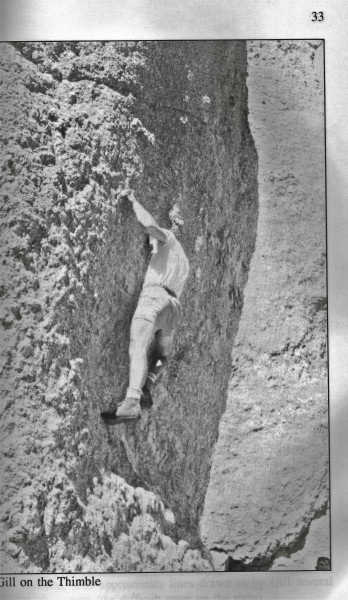 |
| John Gill on the Thimble, from Master of Rock |
But beyond the difficulty (after all Gill had bouldered V9 in 1959!), The Thimble represented the future of climbing. Whether runout on the granite knobs of the Bachar-Yerian (1981) or perched on the miniscule edges and pockets of To Bolt or Not to Be (1986), the climber is on terrain that was first definitively explored by Gill. Sustained steep face climbing, especially once the bolt wars had been resolved (more or less) has been the common currency of cutting-edge climbers world-wide.
Furthermore it marked a new era in terms of the scale and nature of the objective. None of Gill's more famous contemporaries would have viewed the Thimble route as a desirable objective, given the size of it and the blatant risk. Certainly none of them repeated it, nor is it likely they could have, given the specialized strengths of body and mind required for the route. But more interestingly none would really have seen the formation itself as much more than a footnote or afterthought, being too small in stature and too mundane in location to merit the effort and risk of an ascent, especially given that an ascent of El Cap probably posed less physical hazard.
This is where climbing went by the 1990s, to locations unheard of in the 60s or 70s, far way from the canonical sites of Yosemite or the Gunks to out-of-the-way spots such as Rifle or the Red River Gorge or a thousand areas in Europe, sharing in common the resource of steep featured rock. The pursuit of difficulty in climbing inexorably diminished the relevance of many of the big objectives in many people's eyes
The concentration of effort to free climb such a short objective, developed considerably already by Gill with his boulder problems, was a foreign concept in world climbing at the time. Perhaps it was his personality, reflected later in his mathematics career, patient, understated but deeply persistent in the pursuit of a solution to a problem that proved to be crucial. But prior to this ascent, the notion of a climber spending days working out a free-climbing challenge was unheard of. This obsessive quality is taken for granted now, like many of Gill's contributions to the modern sport of climbing, and its origin is for the most part forgotten.
We are all tempted to forget the place of history in the sport of climbing, to see it as lived in the present moment, in some edenic ahistorical state of mind or place. This is small-minded and ungenerous to the past. I try to imagine instead a young man, strong and determined, focusing his considerable powers of mind and body on this rock, listening to the wind whispering through the spires and pine forests of the Black Hills and making the decision, contrary to all expectation, in defiance of the norms of the time, to explore this undiscovered realm. This happened fifty years ago and utterly and irreversibly transformed the idea of climbing forever. Hopefully we can honor this achievement in our own memories and our pursuit of climbing.
Wednesday, September 14, 2011
Walter Bonatti Dead at 81
Walter Bonatti, who was one of the most influential climbers in the postwar scene in the European Alps and Himalayas has died at 81. Noted especially for his solo ascent of the Bonatti Pillar on the Dru in France, he was also embroiled in controversy regarding the Italian expedition to K2 in 1954. He retired for the most part from serious climbing at 35, after a solo new route on the Matterhorn in winter.The author of a number of books on climbing, he was regarded as one of the best writers on the sport.
The best obituary I have seen so far in English is at Planet Mountain.
An excellent profile from the Guardian in the UK is online as well.
At the end of the Guardian profile Bonatti was quoted as saying, "You see, the real essence of mountain climbing – of really knowing and loving the mountains – is not getting to the top. It's having the humility and self-awareness when necessary to be able to stop 100 metres from the summit and make it down alive."
The best obituary I have seen so far in English is at Planet Mountain.
An excellent profile from the Guardian in the UK is online as well.
At the end of the Guardian profile Bonatti was quoted as saying, "You see, the real essence of mountain climbing – of really knowing and loving the mountains – is not getting to the top. It's having the humility and self-awareness when necessary to be able to stop 100 metres from the summit and make it down alive."
Monday, September 12, 2011
Letting Go of Summer
Now that the fall semester is over, the days of multiple visits to the Park have ended. But something else seems to be going on as well. Last Saturday, I hiked up to Upper Chaos to give another go on Barbed Wire Beard, a classic "It's just the one move" kind of problem and found myself completely unmotivated and incredibly tired. I bumbled my way down to look at Freshly Squeezed and still could not shake the sense of deep fatigue.
There is a slightly surreal ambiance of warm sun and wildflowers still in effect up there but for who knows how much longer. Perhaps this fall season will be another long one, allowing a few more visits on weekends but the feeling of lost momentum lingers even as the temperatures become more favorable.
Stasis is the word the ancient Greeks used to describe the absence of progress when opposing forces of equal strength meet, not so much in stable equilibrium but in constant conflict and disruption. For me this is my life as far as bouldering is concerned right now, unproductive effort resulting in frustration. Philosophers such as Aristotle would say that I might working against something in my inner nature and I have thought about this myself. What would a meaningful goal in climbing really consist of? A number? A specific problem? Something else? To realize this goal may require letting go of others, goals that only appear to be meaningful from a sufficient distance.
A webmaster in Europe wrote of a recent piece, "It is targeted to climbers/boulderers who are interested in a deeper sense of doing such an activity and I guess that your article could be hardly understood by any younger climbers..." I am concerned not just about younger climbers not seeing the problems in current climbing attitudes and practice but all climbers. Is climbing merely a way of evading/avoiding the deeper signs of crisis that are sounding everywhere in our time? Perhaps this is the conflict that is weighing on my mind, a conflict that even the grandeur of the Park cannot overcome.
There is a slightly surreal ambiance of warm sun and wildflowers still in effect up there but for who knows how much longer. Perhaps this fall season will be another long one, allowing a few more visits on weekends but the feeling of lost momentum lingers even as the temperatures become more favorable.
 |
| The move on Barbed Wire Beard |
A webmaster in Europe wrote of a recent piece, "It is targeted to climbers/boulderers who are interested in a deeper sense of doing such an activity and I guess that your article could be hardly understood by any younger climbers..." I am concerned not just about younger climbers not seeing the problems in current climbing attitudes and practice but all climbers. Is climbing merely a way of evading/avoiding the deeper signs of crisis that are sounding everywhere in our time? Perhaps this is the conflict that is weighing on my mind, a conflict that even the grandeur of the Park cannot overcome.
Tuesday, September 6, 2011
Chuck Frybergers New Film The Scene
Chuck Fryberger's latest film is premiering at the Boulder Theater tonight so I thought I would give a quick review of it. I have been a big fan of his previous films, Pure and Core, films which garnered mixed reviews from audiences owing in part to Chuck's willingness to experiment with locations, filming techniques, and offbeat themes. With The Scene, those concerns can be set aside. Beautiful camera work, check. Hard routes and problems, check. Interviews with climbing stars, check. But aside from Dave Graham's segment, which is admittedly not very representative of the scene in Boulder (or anywhere else), the feel of the film is much more conventional than past efforts. I found it enjoyable to watch, for sure, but the dynamic visual and emotional range that Chuck has shown elsewhere is mostly absent.
The only scene that hinted at something more innovative, a bit darker and more interesting, was the opener for Bishop, but it's not developed. There are hints of something different in the profile of the comp/pro scene in Innsbruck, a sense of a vacuum beneath the logos, crowds and bright lights, a feeling that, like the slopers and crimps on the problems, the climbers are holding onto, well, nothing really. It is a relief to turn to the limestone around Innsbruck for a little while, though all too brief a while before we are back at a World Cup in Slovenia.
The segment on Spain seems to find its way more successfully than the others though again, there is this avoidance of any exploration of the meaning of all this activity, any searching for a deeper dimension. The potential for getting something more out of an aging Chris Sharma or Dani Andrada seems there but instead they are treated the same as the rest. Just climbers working their way up the chalk marks on a steep limestone wall, apparently with nothing else to do in life. Chris Sharma describes his life as a climber up to this point as mostly "passing through" and the feeling of the film is very similar. Climb a climb, get the word out to the public and sponsors, move on. To where? A muerte?
The only scene that hinted at something more innovative, a bit darker and more interesting, was the opener for Bishop, but it's not developed. There are hints of something different in the profile of the comp/pro scene in Innsbruck, a sense of a vacuum beneath the logos, crowds and bright lights, a feeling that, like the slopers and crimps on the problems, the climbers are holding onto, well, nothing really. It is a relief to turn to the limestone around Innsbruck for a little while, though all too brief a while before we are back at a World Cup in Slovenia.
The segment on Spain seems to find its way more successfully than the others though again, there is this avoidance of any exploration of the meaning of all this activity, any searching for a deeper dimension. The potential for getting something more out of an aging Chris Sharma or Dani Andrada seems there but instead they are treated the same as the rest. Just climbers working their way up the chalk marks on a steep limestone wall, apparently with nothing else to do in life. Chris Sharma describes his life as a climber up to this point as mostly "passing through" and the feeling of the film is very similar. Climb a climb, get the word out to the public and sponsors, move on. To where? A muerte?
Wednesday, August 24, 2011
The Climbing Dictionary

So naturally I would like to start off by saying that this book is amazing. When I showed it to the folks at the counter in the SLC airport, I was immediately upgraded to first class and had 10,000 miles added to my frequent flyer account. When I first opened it, a hundred dollar bill fell out, then another and another, which I found remarkable. Reading it on the plane, I noticed that attractive women continually stopped by my seat and casually dropped phone numbers in my lap, forming a confetti pile which created quite a nuisance by the end of the flight.
Brushing aside this importuning, I delved deeper into the text and found that I had the distinct sense that immediately billions of new neural connections had formed in my brain and that somehow I could see into the future and far into the past. A pleasant glow tingled along all of my chakras. It turns out that the universe does have a purpose and that its design is the work of benevolent yet somewhat absent-minded deity who resembles Dumbledore. Pretty cool so far, I thought, but how can this little volume help me as a climber?
Well as it turns out it can help a lot. After getting back to Colorado, I immediately went bouldering and now, armed with a better command of the lingo such as Euroblow and drive-by and gaston, started crushing my projects left and right. In fact last week I cut up my RMNP annual pass since I had nothing left to do there. I may in fact have to go back to Rifle and build up my jessery skills.
I have also lost five pounds and recently discovered a gold vein in the backyard while cleaning up after the dog. Now these results may not be typical, but why take a chance and miss the fun? For more information, visit the website http://www.climbingterms.com/ and become enlightened.
Subscribe to:
Posts (Atom)


 Posts
Posts

