Over the past weekend the climbing world was afire with reports of a high-altitude confrontation between three elite Western mountaineers and a group of native Nepali climbers (I am no longer certain that "Sherpa" is appropriate usage) high on the Lhotse Face of Everest. There are literally dozens of accounts of the incident but the best are probably from UKClimbing and Planet Mountain. The apparent underlying cause of the incident, which involved verbal and physical assault as well as death threats, was a perceived encroachment on the terrain and tasks that the Nepali group was involved with as they were fixing ropes for the spring season on the regular route. I won't relate or try to reconcile the varying accounts of what happened, and I am sure that the final word has not been said (nor may ever be said) about what actually happened. Certainly the incident was serious enough to cause Ueli Steck to state publicly "My trust is gone. I could not go back to this mountain."
One of the issues that is lying just below the surface in many of these accounts is the uneasy relationship between the native economy, native labor, and Western capital. I am not sure how much it is a matter of public record the degree to which Nepal depends on a regular infusion of money via the single destination of Everest's summit. There is no question that Nepal is not a rich country by Western standards and that tourist and mountaineering traffic is a crucial economic benefit. Even for an American or European of means, Everest is a substantial investment of time and money, an investment that, by the way, sees no reciprocity from Nepalese citizens in terms of their ability to travel to America or Europe to climb. Nor is it clear to me exactly how the entire country of Nepal benefits from this kind of activity. I am not sure that the interested parties would be entirely enthusiastic about this question being explored more deeply. There is no question in my mind that the lack of clarity regarding even terminology for "Sherpas" and what they do and how they are paid reflects the problems with a relationship that has its roots in an oppressive colonial past, a past that reverberates into the present.
This brings me back to the deeper problem, one that the climbing world seems reluctant to face, that climbing is, at its heart, a pursuit of the economically privileged often in areas of the world where such privilege might be viewed with suspicion and hostility. I think climbers like to believe that somehow by expending time and capital (which in the West are pretty much the same thing) in a pursuit that is basically useless, that somehow it's innocent or at least innocuous. Climbing narratives return time and again to freedom and appeal to the notion that in the mountains you are somehow free of the structures of society. In the eyes of one author, "Everest is not for climbers" because of "the dues—not dollars—I believe one should pay in order to be granted access to earth’s most rarified places." To me, this sentiment illustrates perfectly the myopia in the climbing world, the failure to see that dues paid in the mountains, any mountains, (I can't help but think of them a bit as country clubs here) are intimately linked with dollars and their relatively easy availability. I agree with the thesis that Everest is now a site dominated by commercialism. But ultimately so is every other major climbing area, to some degree or another. I look at the price of climbing equipment, tickets for flights to far-off places, opportunity costs for not working and I ask, "Who can afford this?" The myth of "dirtbag" freedom and the realities of economics rudely collide in our culture, which bestows, with documented increasing regularity, its economic blessings on an ever-narrowing caste, a caste which defines itself in no small part by rituals of recreational consumption, whether on the slopes of Everest or elsewhere. The freedom of the hills requires fairly high start-up costs for most of us.
I don't expect too much analysis of the 2013 Everest season to dwell on these deeper issues. So much media energy is spent on creating images (verbal and pictorial) for consumption by sponsors and consumers alike that it is inevitable, indeed even essential, that the tensions highlighted by this tragic episode be papered over and the parties involved agree to an uneasy truce. The show must go on. But responsible writers on this episode, in my view, will have to return to this fundamental contradiction at the heart of the sport, that our pursuit of freedom and personal fulfillment will ultimately have a cost to someone or something, somewhere.
Wednesday, May 1, 2013

Saturday, April 27, 2013
Cracked Bolt Hangers and Other Nightmares: The Future of Fixed Anchors
 |
| Can you imagine clipping this? (Via http://www.adventurerock.com/sections/thescene/blog/the-humble-916th-wrench/) |
If you have been climbing for a while, you may recall encounters with fixed protection that was well past its sell-by date. Drooping,twisted soft-iron pitons with rings, rusted-out angles, rotten lost-arrows and a spectrum of lame bolts and half-assed hangers were par for the course. American ambivalence about fixed protection resulted in quite a variety of unsafe and ineffective methods and tools for installing bolts and pitons. In some areas, the ever-present threat of chopping made many reluctant to invest in high-quality protection. In the 21st century this began to change as an older generation and attitude gave way to a more pragmatic approach to the realities of the climbing environment. Things seemed settled for once.
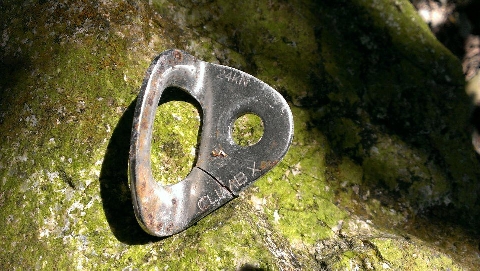 |
| A cracked hanger (image via Gripped and rockclimbing,com) |
Now comes word of cracked bolt-hangers from a poster at rockclimbing.com who put up some photos on one of the forums and then had the story picked up by Gripped Magazine's website. Obviously this story will develop over the coming weeks but the primary issue is that this failure, if confirmed, is in a device that is in many instances absolutely mission-critical, non-redundant and much less subject to the variables and stresses that say, an actual bolt in the rock or a cam might undergo. In other words, a modern hanger failure simply should not happen, ever. This makes me wonder about what's next.
As climbing expands as a sport, the likelihood of ever-increased use of fixed anchors expands as well. Now there is a UIAA standard for "rock anchors" that focuses on materials and strength tests. There are probably others that can be added such as the CWA and so on. However (and this follows only a cursory search) there appears to be a remarkable lack of publicly available rigorous current research on the subject of placing, assessing and maintaining fixed anchors in the field. Given the fact that there are many freelance bolters out there operating in a diverse range of rock types and environments, it seems logical that there will need to be a serious empirical field-based study of the performance of fixed anchors and any accessory gear including fixed draws, links etc to ascertain future best practices in the manufacturing, installing, and maintenance of these now-essential tools. Will there be a problem commissioning and funding such a study given its potentially controversial findings? As with the integrity of fixed climbing anchors themselves, only time will tell.
If you have suggestions on where to find publicly available, scientifically rigorous research as opposed to anecdotally-based accounts, please let me know. The ASCA is a good place to start but there seems to be room for improvement in terms of resources.
Monday, April 22, 2013
Layton Kor 1938-2013
 |
| Galen Rowell's iconic portrait of Kor at the top of the Salathe Wall |
It's a cold snowy day in Boulder Colorado and I just learned this morning about the death of Layton Kor at the age of 74. I am going to go out on a limb here and describe his passing as the first of the legendary American climbers of his era. If there was vote over who was the defining presence in American climbing in the 1960s, it would be a choice primarily between Royal Robbins and Layton Kor. For many, there was Kor's manic irrepressible drive to climb all that there was to climb, his deeply working class roots (he was a stone mason and never enjoyed financial prosperity in his later years as did Robbins or Yvon Chouinard) and his sudden disappearance from the scene after the tragic death of John Harlin on the Eiger Direct; all this was the stuff of legend. If you are a climber in the environs of Boulder Colorado, you somehow climb in the shadow of Kor, always.
Stories abound of a larger-than-life personality driven by equal parts comic genius and raw determination. Among the best is by far Pat Ament's account of his first venture with Kor into the Black Canyon, a failure as far as the climbing was concerned, a triumph for climbing literature as it captured an essential portrait of the man at his prime. In Colorado, he simply dominated the climbing scene as no climber has since, lending his name to classic routes on too many significant walls and peaks to count. Eldorado Canyon has become synonymous with Kor, whose routes (and their names) have been enshrined in legend. Indeed one of the contributions of Kor was his names for climbs, by turns comic, dramatic, or comprising achingly bad puns, puns that might well mask desperate unprotected free climbing and precarious aid.
In a time dominated by serious California climbers who strode across the Yosemite Valley landscape like colossi, Kor came in and simply went to work, fearing neither the steep smooth granite nor the insular social scene. In a sense, he was a spiritual cousin of Warren Harding, ready to poke fun at those he perceived as too full of themselves and tough as nails on the rock as the situation demanded. Though ironically I know many people who knew Kor well, I never had the opportunity to meet him myself. There is no question in my mind that he shaped an era in American climbing that is passing away and that will never be seen again.
Friday, March 22, 2013
Chasing Winter: A Review (Plus a chance to win a free download!)
 |
| Mr Postman V12 |
In recent times, it seems that the idea of paying for climbing video is obsolete. Outside of marquee franchises such as Big Up and the Reel Rock Tour, climbers have grown accustomed to keeping up with the latest new routes, problems and personalities via free video on the Internet. As the bigger companies have seized on the value of this media, increasingly sophisticated productions have emerged though not necessarily more compelling or more interesting. The position of an independent operator in this climate is a tricky one, yet some of the most innovative video is coming from this source. Whether it was Andrew Kornylak's A Fine Line, Unclesombody's films about Font or Haroun Souriji with his Better Than Chocolate, or the makers of Chasing Winter, Paul Robinson and Alex Kahn, known as PRAK media, with The Schengen Files, I found these productions more personal, less commercial yet not amateurish in their conception or their look.

Chasing Winter is another excellent film in this category, focusing on the bouldering close to Cape Town as well as Rocklands. The film could have focused entirely on the gorgeous setting and unusual shapes, colors, and textures of Topside, a sandstone area close to the city. It seems the area is one with sensitive access issues so hopefully this film will not exacerbate them. I would have preferred a bit more background on the history of the area and more words from the locals on the scene and its history. This truly looks like one of the best urban bouldering areas around.
Things shift gear with the introduction of Ashima Shirashi, the 11 year-old girl wonder from NYC. Working the V14 crimps of Amandla is one thing, but crushing the near-horizontal V13 roof of Fragile Steps is another. Very impressive climbing but more interesting is the clean and straightforward style she brings to the ascent of this problem and the closing problem, Steady Plums Direct, also V13. Her interviews show a modest yet focused young girl with no hint of the incredible ticklist that she has made so far. It's kind of cool to see climbers that I see as young mentoring someone even younger on a trip like this.

Carlo Traversi gets some quality screen time on three really good looking problems, Paranormal Activity V14, a sloper traverse, Groundswell V13, a truly unique diagonalling crimp rail (Carlo's FA) and the problem I would love to do, Mirta V14, a brilliant crimpy roof. All of these are on immaculate bone-white sandstone that looks more like limestone. Carlo has power to waste and each of these problems bring that out.

Throughout the hour-long film, Paul remains the focus of things and the narrator. I think he does a great job with this, keeping things moving but letting the viewer absorb the gorgeous setting and remarkable problems. For some reason, I found his ascent of No Church in the Wild V13 the most interesting. A stark white panel of stone, spattered with grafitti, its five or so moves illustrate the essence of crimpy bouldering. There is nothing extraneous, just pure technique and power on an overhanging wall.
Now alpinists may scoff at the title and there is certainly no snow or ice in sight. But for bouldering, winter is more a set of conditions or state of mind. Crisp edges, sticky slopers, and low humidity are at the heart of it and as Paul says in the beginning of the film, this is what dedicated boulderers spend the year chasing. I think that anyone looking for a video to inspire them to find their own winter will not do better than this subtle and understated film.
You can find it on sale for a limited time at 27crags.com and as a bonus, win a free download by liking Mountains and Water on Facebook and messaging the answer to this question "Name the bay that can be seen from many of the topside areas? This bay is the link between the Atlantic and Indian Ocean." A winner will be drawn at random from the answers I receive. (If you don't do Facebook, you can also post the answer as a comment to this review, though it will not be published) Good luck!
Tuesday, March 19, 2013
Pro Climbers and Social Media
Just the other day, I read an interview with a well-known American climber and was going to post congratulations to his Facebook page when I found that I couldn't access it. Without my knowing anything about it, I had been blocked, which was curious since we hadn't had any contact, direct or indirect, in weeks, if not longer. Asking around, I found I was not not the only climbing writer to get this treatment and in fact a tweet from this climber informed the Twitterverse that "I love blocking jerkoffs on Facebook."
Now it's neither here nor there to me if his FB page is inaccessible since I can keep track of this individual's exploits due to his numerous other self-promotional activities. And if I am considered a "jerkoff" with no further explanation (an email was sent but no answer so far) then that's pretty much it I guess. It wouldn't be the first time. But it raises an important issue for climbers who are hoping to leverage their presence on social media, an issue that has emerged with increasing urgency in other sports. The problem is how to keep the "dark side" under wraps when the urge strikes you to say what you really think. As they say about Vegas, what happens on the Internet stays on the Internet. This impulse to blurt out something silly is something that a well-known (and apparently former?) magazine editor has done in the past with this blog and indeed he recently speculated on Twitter about creating a video of himself chipping boulders with "a Peter Beal mask." Clever stuff as usual, but flattery like this will get you only so far in life.
Anyway, in the new world of constant social media self-promotion, aspiring "athletes" need to be careful not to cross the line from being your own biggest fan to becoming too ardent a defender of your reputation and your tribe. The vibe is all about "psyche" and "stoke" and inclusiveness even as you name drop the places and personalities that give that extra shine to your aura. Keep the humblebrag quotient high and don't let your Instagram feed look too much like this. And remember to make nice with the little people as you rise to stardom. They're the ones you'll have to hang out with again on the way back down.
Friday, March 15, 2013
Trees Versus Bolts
Just saw this remarkable thread on Mountain Project about rap anchor bolts being chopped for a descent off a formation at Red Rocks.
http://mountainproject.com/v/retrobolted-anchors-on-lotta-balls-descent-route-removed/108038113
Also http://mountainproject.com/v/bolted-descents/107439728__1
One individual commented " Commercial bolting in RR is a problem. Locals taking care of the situation is exactly what should have happened. We shouldn't be worrying about some trees that will never last as long as the rock, regardless if the rope threads the same. Slings last a long time in the desert compared to the most other wet parts of the country. The only people this could be an eye sore is to climbers which should be used to seeing slings on trees. To clean it up, feel free to cut it off and add your own."
Setting aside the obvious problems in the individual comment above, I wonder how many climbers are still locked in the old-school mindset that "natural" rappel anchors on popular routes are somehow preferable to solid permanent camouflaged bolted ones. Having rapped off plenty of crappy old webbing back in the day, I want to say good riddance to that attitude. Better to avoid trampling vegetation and killing trees, even if some climbers disdain this kind of bolting as "convenience anchors." Maybe after the 20th or 30th ascent of the route, convenience overrides further impact on the cliff's ecosystem?
Subscribe to:
Posts (Atom)


 Posts

